Blog

All Madison Toyota Dealer Nashville Toyota North Madison Used Cars Nashville Toyota New Cars Nashville Toyota North Used Cars Madison Toyota Service Madison New Cars Nashville Toyota North Service Nashville Toyota Parts Blog
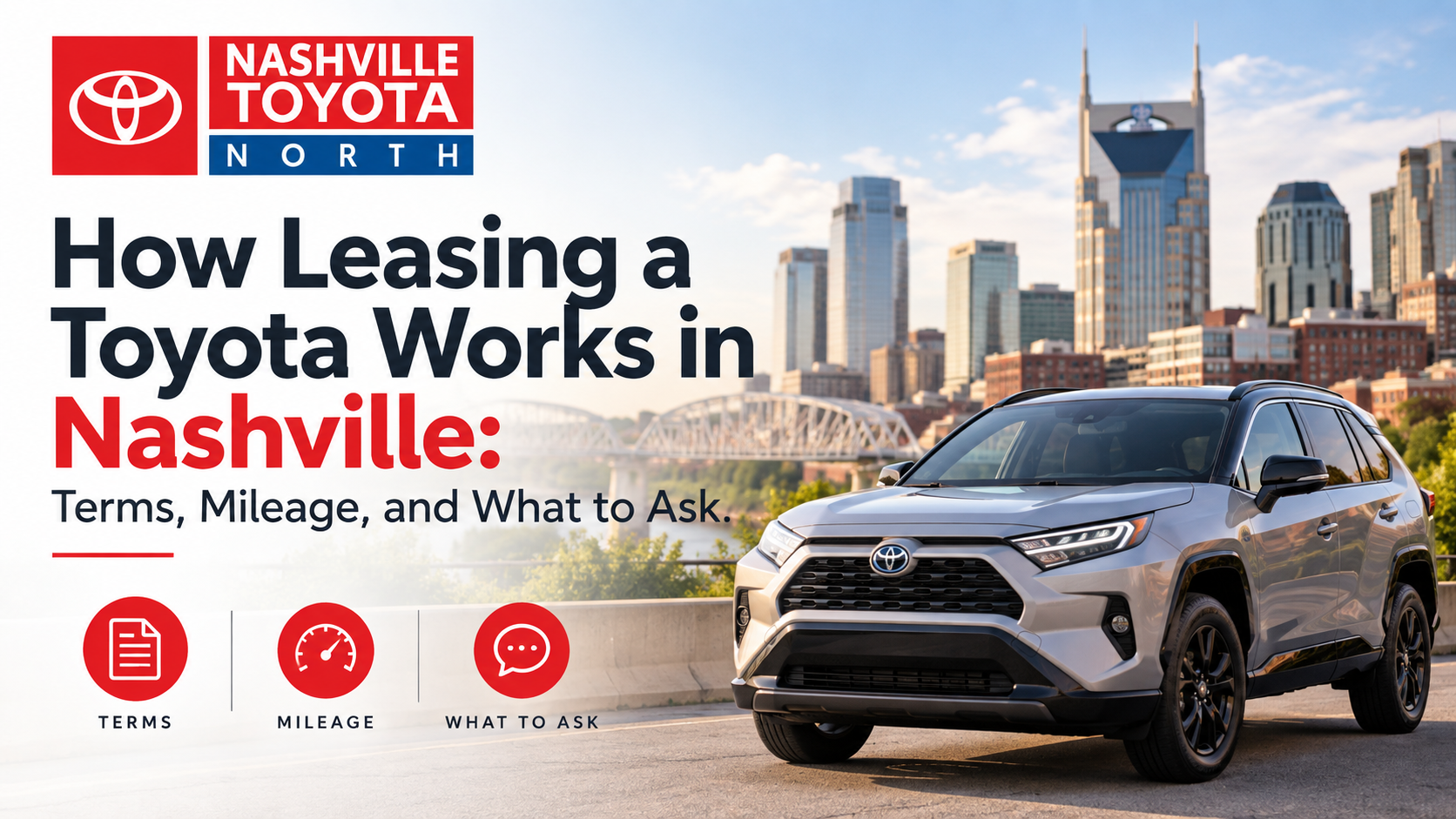
Toyota RAV4 with the Nashville skyline promoting a guide to Toyota leasing terms, mileage, and questions to ask at Nashville Toyota North.

How Leasing a Toyota Works in Nashville: Terms, Mileage, and What to Ask

If you have only ever bought cars, a lease can feel like a different language. Residual value. Money factor. Disposition fee. None of it is complicated once somebody explains it in plain English, but almost nobody does, and first time lessees often sign without fully understanding what they agreed to. This guide covers how a lease actually works, what your payment is really paying for, how mileage limits behave, what condition your vehicle needs to be in at turn-in, what your choices are at the end, and the questions to ask before you sign. One note up front: this article contains no payment figures or offer terms. Lease pricing moves constantly and depends on the model, the term, your mileage tier, and your credit qualification. For current numbers, contact our finance department and ask for a written quote. What a lease actually is When you finance a purchase, you are borrowing money to buy the whole vehicle. Every payment chips away at the entire value of the car, and at the end you own it. When you lease, you are paying only for the portion of the vehicle you use up during the term, the slice you consume rather than the whole pie. That slice has a name: depreciation. It is the difference between what the vehicle is worth when you drive it off the lot and what it is projected to be worth on the day you bring it back. The lender, which for most Toyota leases is Toyota Financial Services, estimates that ending value in advance and writes it into your contract as the residual value. You pay for the gap between those two numbers, spread across your term, plus a finance charge, because the lender is fronting money for a vehicle it still owns. At the end you hand the keys back, or you buy it. That is the whole concept. Everything else is detail. What your monthly payment is made of A lease payment has three conceptual layers. The depreciation layer. The largest piece for most leases: the projected drop in value over your term, divided by the number of months. A vehicle that holds its value well leaves a smaller gap to pay for, which is one reason lease terms differ between models with similar sticker prices. The finance charge layer. Called rent charge in lease language and expressed as a money factor rather than an interest rate. Same idea as interest, different notation. The tax and fee layer. Sales tax handling on leases in Tennessee, plus any fees your contract itemizes, such as an acquisition fee at the start and a disposition fee at the end. Toyota Financial Services lists a disposition fee among the possible lease-end charges, so ask whether yours applies and what it is. Three levers move that payment: the negotiated price of the vehicle, the length of the term, and your mileage allowance. Yes, the price is negotiable on a lease, exactly as on a purchase, and a lower agreed price means a smaller depreciation gap to cover. First time lessees routinely skip that conversation because the deal is presented as a monthly number, and a monthly number hides which lever was pulled. Toyota Financial Services offers terms from 24 to 60 months on new Toyota vehicles and qualified Toyota Certified vehicles, so the term is a choice too. Mileage, and what that means in Nashville Every lease includes a mileage allowance. Drive under it and nothing happens. Drive over it and you owe for the overage at turn-in. Toyota Financial Services publishes two program tiers: a standard lease with up to 15,000 miles per year, and a low mileage lease with up to 10,000 miles per year. Your specific allowance is written into your lease agreement, which Toyota Financial Services says plainly is where to look for it. Now the local part. Census figures put the mean travel time to work in Nashville-Davidson at roughly 24.7 minutes each way, but averages hide the reality of this metro. Commuting in from Hendersonville, Mount Juliet, Spring Hill, Murfreesboro or Clarksville is a very different mileage picture from a hop across East Nashville. Do this math before you pick a tier. Take your round trip commute, multiply by the days you actually drive it in a week, multiply by roughly 50 weeks, then add weekend driving, kids’ activities, and trips to the Smokies or to see family. That total is your real annual mileage. Compare it honestly to the allowance you are considering. The classic first-timer mistake is choosing the lower tier because the payment looks better, then discovering at month 30 that you are on pace to blow past the limit. The higher allowance up front is usually simpler than the overage later. What happens if you go over Nothing happens month to month. There is no alert, no penalty at the time, no adjustment to your payment. The bill arrives at turn-in. Toyota Financial Services states that exceeding your allowance results in additional charges at a set rate defined in your lease agreement, and its own FAQ describes that rate as typically fifteen cents per mile for leases through Toyota Financial Services. Your contract governs, so confirm the rate in your own paperwork. Two things worth knowing. First, if you buy the vehicle at lease end instead of returning it, excess mileage generally stops being an issue, because you are keeping the car rather than handing back one with more wear than projected. Second, check your odometer against your pace at least once a year, using the mileage calculator in the Toyota Financial Services account portal. Finding out at month 12 gives you three years to adjust. Finding out at month 35 gives you nothing. Wear and use at turn-in Normal use is fine and priced in. Damage beyond that is billable. Toyota Financial Services defines excess wear and use as damage beyond normal wear and use, and gives examples. On the exterior: scratches or dents greater than the size of a credit card that penetrate the paint, windshield cracks or stars or bull’s-eyes, bent or broken or missing lights and mirrors, tires with exposed cords or sidewall damage, and wheel damage greater than a credit card. On the interior: cuts, tears, burns or stains greater than a credit card, missing keys or remotes or equipment, and broken or malfunctioning parts. That credit card standard is genuinely useful. Hold one against anything you are unsure about. Toyota Financial Services also offers a courtesy pre-inspection through Toyota dealers and recommends completing it within 60 days before your return. Take it. It tells you what would be charged while you still have time to handle a windshield chip or a set of tires at your own price. For leases signed after January 27, 2026, Toyota Financial Services states it will waive excess wear and use charges up to a maximum of $500, excluding missing equipment, parts and accessories such as missing keys and remote entry devices. Confirm how that applies to your contract. The end of the lease: three doors As your maturity date approaches, Toyota Financial Services describes three paths. Return it. Bring the vehicle back to an authorized Toyota or Lexus dealer. Toyota Financial Services notes that your originating dealer is required to process the return, and recommends calling about 30 days before maturity to schedule the appointment. Bring keys, manuals, original equipment and an odometer disclosure statement, notify Toyota Financial Services of the return, and cancel any automated payments afterward. Settle any excess mileage, excess wear, disposition fee, or unpaid amounts. Buy it. Purchase the vehicle you have been driving. Your contract contains a purchase option, and it is worth evaluating rather than dismissing. You know the entire service history because it is yours. Lease or buy something new. Turn in the current vehicle and start fresh. This is why leasing appeals to people who want a new vehicle every few years without managing a resale. Start the conversation about which door you are taking sixty to ninety days out, not the week of. Browse the new Toyota lineup while you have room to plan. Lease versus buy: who each suits There is no universally cheaper option, and anyone who tells you otherwise is selling something. The right answer depends on how you use a vehicle. Leasing tends to suit drivers with predictable, moderate mileage; people who want a new vehicle every two to four years; those who prefer most of the term covered by the factory warranty; and anyone who wants current safety technology on a short cycle. Buying tends to suit high mileage drivers and long distance commuters; people who keep vehicles past the payoff and want years without a car payment; drivers who want to modify their vehicle; and anyone whose annual mileage swings year to year. The honest test: leasing rewards predictability, buying rewards longevity. If you cannot forecast your driving within a few thousand miles a year, that uncertainty has a cost under a lease. Questions to ask at the dealership Bring this list, and ask for the answers in writing. What is the agreed price of the vehicle in this lease, and is it negotiable? What is the term in months, and what other terms are available? What is the annual mileage allowance, and what would a higher tier change? What is the excess mileage rate stated in this specific contract? What is the total amount due at signing, itemized, and what is each line for? Is there an acquisition fee, and is it in the payment or due up front? Is there a disposition fee at lease end, and how much? What is the residual value, and what is the purchase option at the end? Is gap protection included, and if not, what does it cost? What maintenance is covered during the term, and what is my responsibility? Are there penalties for ending the lease early, and what are they? How does the turn-in and pre-inspection process work? If any answer is vague, ask again. A lease is a multi-year contract, and every one of these numbers is written into it somewhere. Where to go from here Leasing is not complicated once you know what the payment covers and where the limits are. It fits some drivers well and others poorly, and the difference usually comes down to mileage and how long you keep a vehicle. To talk through whether a lease makes sense for you, start with our leasing options page, or reach out to the finance team for current program details and a written quote.

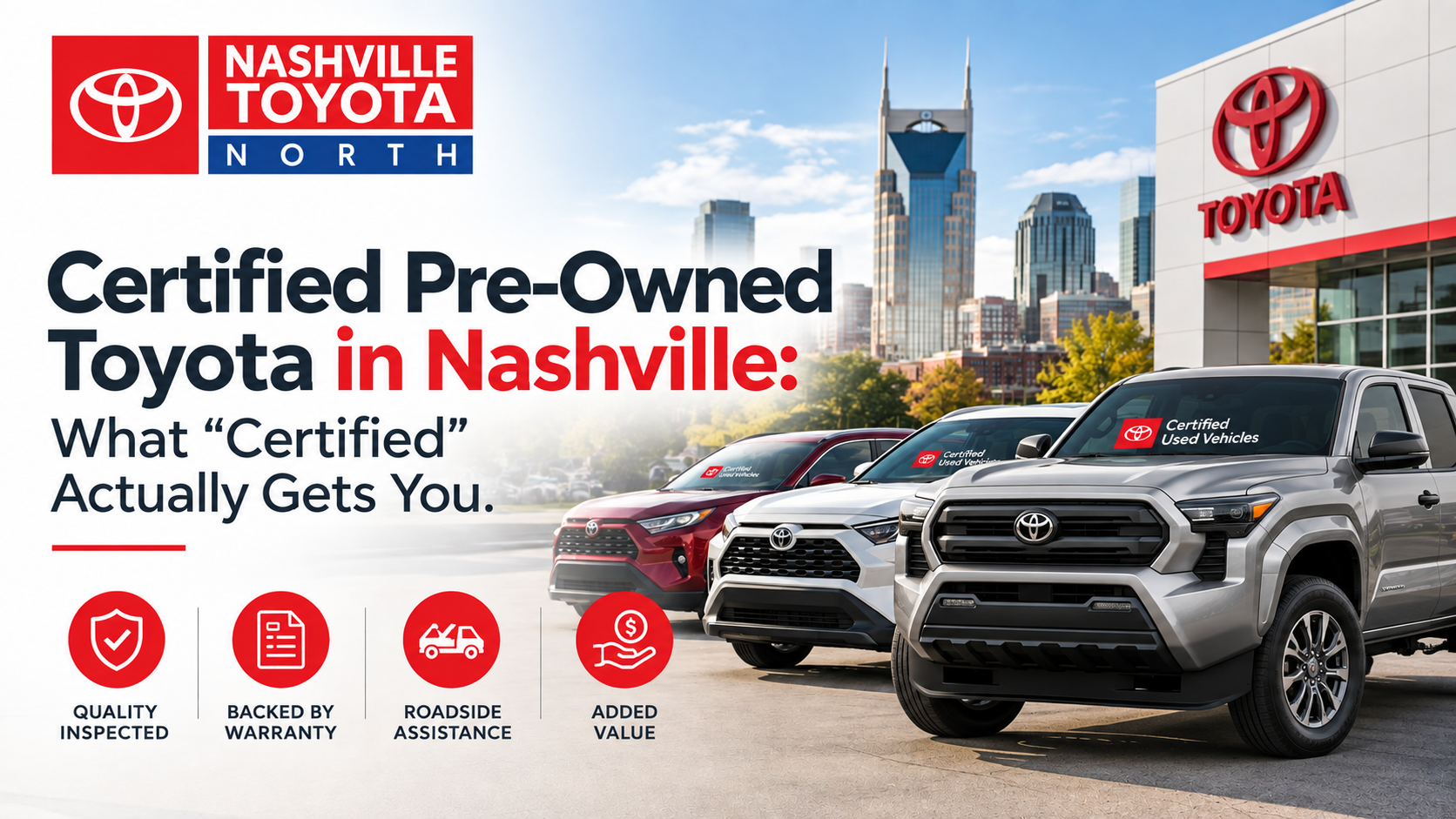
Certified Pre Owned Toyota Tacoma and SUVs at Nashville Toyota North, highlighting inspection, warranty, roadside assistance, and added value.

Certified Pre-Owned Toyota in Nashville: What “Certified” Actually Gets You

“Certified” is one of the most overused words in the car business. Plenty of vehicles get advertised as certified when all that really happened was a shop check and a dealer’s own promise. So when a Nashville shopper asks what a Certified Pre-Owned Toyota actually gets them, the honest answer starts with a distinction: there is a difference between a car a dealership calls certified and a car that carries Toyota Certified Used Vehicles status, which is a manufacturer program with published requirements and factory-backed coverage. This guide covers what Toyota’s certification includes, how the program’s two tiers differ, how a certified Toyota compares to an ordinary used car and to a brand new one, who the program genuinely makes sense for, and what to verify before you sign anything. What “Toyota Certified” means Toyota Certified Used Vehicles is Toyota’s own program, not a dealer-created label. A vehicle has to meet Toyota’s eligibility rules on age and mileage, pass a required inspection, be reconditioned to program standards, and come with a CARFAX Vehicle History Report. Once it qualifies, the coverage that follows is backed by Toyota and honored at Toyota dealerships, not just at the store that sold it. That last point matters more than most people realize. A dealer-certified car ties your coverage to one business. Factory certification travels. Toyota runs two certified tiers, and they are not the same This is the single most important thing to understand, and it is where most shoppers get tripped up. Toyota’s certified program has two levels, Gold Certified and Silver Certified, and the terms differ meaningfully between them. If someone tells you a Toyota is “certified” without telling you which tier, you do not yet have enough information. Gold Certified Gold is the tier most people picture when they think of Toyota CPO. According to Toyota’s certified program brochure, these vehicles receive a 160-point Quality Assurance Inspection, and hybrids get a 174-point inspection, which adds 14 checks specific to hybrid systems. Coverage on Gold Certified vehicles, per Toyota, includes: A 12-month/12,000-mile Limited Comprehensive Warranty with a $0 deductible A 7-year/100,000-mile Limited Powertrain Warranty with a $0 deductible 7-year/100,000-mile Roadside Assistance Toyota’s newsroom describes Gold Certified eligibility as vehicles up to 6 model years old with no more than 85,000 miles. Silver Certified Silver is the newer, broader tier, and it exists to bring older and higher-mileage Toyotas into the certified program. Toyota’s newsroom describes Silver Certified vehicles as up to 10 model years old, generally in the 60,000 to 125,000 mile range, receiving a 136-point minimum quality assurance inspection. Silver’s coverage is shorter. Toyota’s warranty page lists Silver Certified as carrying a 12-month/12,000-mile Limited Powertrain Warranty, alongside the same 12-month/12,000-mile Limited Comprehensive Warranty, with roadside assistance running 12 months/12,000 miles. So both tiers give you a factory inspection, a vehicle history report, comprehensive coverage for the first year, and roadside help. The powertrain and roadside terms are where Gold and Silver diverge sharply. One nuance worth reading twice Toyota’s published terms describe the Gold powertrain coverage as 7 years or 100,000 total vehicle miles. “Total vehicle miles” refers to the odometer reading, not miles you personally add after buying. On a vehicle that already shows 70,000 miles, the mileage side of that warranty has considerably less runway than the headline number suggests. The time side and the mileage side both apply, and whichever arrives first ends the coverage. Toyota also notes the powertrain coverage is transferable at no cost if you sell the vehicle before it expires, which is a real resale advantage. What the inspection actually covers An inspection point count is a marketing number on its own. What makes it useful is knowing that Toyota specifies what has to be checked and what has to be corrected before a vehicle can be certified. The inspection covers mechanical systems, the drivetrain, brakes, steering and suspension, electrical and electronics, the interior and exterior condition, tires, and on hybrids, the hybrid-specific components that a general-purpose used car inspection would not touch. The practical value is not the number. It is that a technician working from a manufacturer checklist has to bring the vehicle up to a defined standard, and that a CARFAX report has to be part of the file. You are buying a documented process, not a handshake. On hybrids specifically, Toyota’s brochure notes an 8-year/100,000-mile Factory Hybrid Vehicle Battery Warranty, and a 10-year/150,000-mile hybrid battery warranty for 2020 and later model years. If you are considering a certified RAV4 Hybrid, Camry Hybrid, or Prius, that factory battery coverage is a separate thing from the certified warranty and is worth confirming on the specific vehicle. CPO versus a regular used Toyota Here is the honest comparison. A regular used Toyota is typically sold as is or with whatever is left of the original factory warranty. There is no required manufacturer inspection, no required reconditioning standard, and no added factory-backed coverage. The upside is flexibility: the used market includes vehicles that would never qualify for certification, including higher-mileage cars, older model years, and non-Toyota trade-ins. A certified Toyota narrows the field to vehicles that cleared Toyota’s bar, then attaches coverage on top. You are trading selection breadth for verification and warranty. Neither is automatically the right call. If you are the kind of buyer who will get an independent pre-purchase inspection, has a mechanic you trust, and is comfortable absorbing a repair, a well-chosen non-certified used Toyota can be an excellent vehicle. If you would rather not carry that risk, certification is doing real work for you. You can compare both sides directly on our used vehicle search, where certified vehicles can be filtered separately from the rest. CPO versus new A new Toyota gives you the full factory warranty from mile zero, the current model year’s features and safety technology, your exact choice of trim and color if you are willing to wait or order, and no prior owner history to evaluate. A certified Toyota gives you a vehicle that has already absorbed its steepest depreciation, with a documented history and factory-backed coverage that closes much of the peace-of-mind gap. What you give up is time and miles already on the clock, a shorter coverage runway than a new car’s, and the constraint of choosing from vehicles that exist rather than configuring one. The comparison gets more interesting on Gold Certified vehicles, because a 7-year/100,000-mile powertrain term on a relatively recent Toyota can be a genuinely long horizon. On a Silver Certified vehicle at 12 months/12,000 miles, the coverage is real but modest, and the decision looks more like a normal used car purchase with a safety net attached. Who certified pre-owned actually makes sense for Certification tends to be a strong fit if you: Want a recent Toyota without buying the newest model year Plan to keep the vehicle long enough that powertrain coverage matters Are buying a hybrid and want the hybrid-specific inspection points and battery coverage confirmed Do not have a trusted independent mechanic and would rather rely on a documented factory process Value the transferability of coverage because you expect to sell in a few years Certification tends to matter less if you: Are shopping for an older or higher-mileage vehicle that falls outside program eligibility anyway Are buying a non-Toyota trade-in, which cannot be Toyota Certified regardless of condition Already plan an independent inspection and are comfortable managing repair risk yourself Expect to sell or trade within a very short window What to check before you buy Bring this list with you. 1. Ask which tier. Gold or Silver. Get it in writing. The powertrain and roadside terms differ substantially, and “certified” alone does not tell you which you are getting. 2. Confirm it is Toyota Certified, not dealer certified. These are different products with different backing. Ask to see the certification paperwork. 3. Read the odometer against the warranty. Gold powertrain coverage is stated in total vehicle miles. Do the subtraction on the actual car before you assume you have the full 100,000. 4. Read the CARFAX yourself. Do not accept a summary. Look at ownership count, title history, accident records, and whether service intervals were kept. 5. Ask for the completed inspection documentation. A certified vehicle went through a defined checklist. Ask what was found and what was replaced or repaired. 6. Check hybrid battery coverage separately. If it is a hybrid, confirm the model year and the applicable battery warranty terms on that specific vehicle. 7. Confirm what is excluded. Every warranty has exclusions and conditions. Read them before, not after. 8. Verify remaining factory coverage. On a newer certified vehicle, some original factory warranty may still be in force alongside the certified coverage. 9. Test drive it like you mean it. Highway speed, rough pavement, full braking, every electronic feature, the climate system, and the infotainment. 10. Understand the financing separately from the car. Terms, rate, and length are their own decision. Our financing page is a reasonable place to start sorting that out before you are sitting at a desk. The short version Toyota Certified Used Vehicles is a real manufacturer program with published standards, and it delivers something a generic “certified” label does not: a required inspection, a required vehicle history report, and factory-backed coverage honored across Toyota dealerships. The catch is that the program has two tiers with meaningfully different terms, and the difference between Gold and Silver is the first question you should ask about any certified Toyota you are considering. If you want to look at what certification covers in more detail, our certified pre-owned page breaks down the program, and the team at Nashville Toyota North can walk you through the tier, the inspection record, and the history report on any certified vehicle you are considering.


Toyota RAV4 and Toyota Highlander with the Nashville skyline, comparing family friendly SUV options at Nashville Toyota North.

Toyota RAV4 vs Toyota Highlander: Which SUV Fits Your Nashville Family?

Two families walk into a Toyota showroom with nearly identical needs, and they drive home in different SUVs. That is not a sales trick. The RAV4 and the Highlander are both excellent, and they are built for different lives. The trick is knowing which life is yours before you start comparing feature lists. Here is a simple way to think it through. Start With One Question: Do You Need a Third Row? Almost every RAV4 versus Highlander decision comes down to this, and it is worth answering honestly before anything else. The Highlander offers a third row. Toyota builds it with 7 passenger seating using second row captain’s chairs, or 8 passenger seating when you choose the second row bench. The RAV4 does not offer a third row at all. That sounds like a simple yes or no, but the honest version is a little more nuanced. Ask yourself how often you actually carry more than five people. If the answer is “every single weekday, because I drive the carpool,” the Highlander is doing real work for you. If the answer is “twice a year when the cousins visit,” you may be buying a third row that mostly sits folded flat. Plenty of Nashville families land in the middle. You have two kids now, but you also have grandparents in Hendersonville who ride along on Sunday afternoons, and you host the postgame crew after middle school football. If the third row is your relief valve for those weeks, it earns its keep. If it is insurance against a maybe, keep reading. Cargo Space and the Reality of Parking Here Here is where Nashville itself starts voting. The RAV4 is the smaller vehicle, and smaller matters more in this city than the spec sheet suggests. Think about the parking garage in Green Hills on a Saturday. Think about the tight angled spaces along 12South, the older lots around Hillsboro Village, and the daily reality of a school pickup line where you are threading between a curb and a row of parked cars. A smaller footprint takes the tension out of all of that. The RAV4 also carries more than people expect. With the second row folded down, the 2026 RAV4 opens up to as much as 70.4 cubic feet of cargo space, and the new folding rear seatback lies flat. That is genuinely useful room for the Costco run, a dorm move to MTSU, or a weekend of camping gear headed toward Percy Priest. The Highlander gives you more flexibility instead of just more volume. Because it has three rows, you can mix and match: five people plus a lot of cargo, or seven people plus a modest amount, or two people plus a truly large load. That third row is a switch you flip depending on the day. The tradeoff is a longer vehicle to maneuver and park. A useful way to frame it: the RAV4 is easier to live with every day, and the Highlander is easier to live with on your hardest days. Which kind of day defines your week? Both Offer a Hybrid, but They Solve Different Problems Good news for anyone watching the gas gauge on an I-24 commute. Both of these SUVs are available as hybrids, and you do not have to give up much of anything to get one. The RAV4 goes furthest here. For 2026, Toyota moved the RAV4 to a fully electrified lineup, offering a choice of RAV4 Hybrid or RAV4 Plug-in Hybrid models. There is no non-hybrid RAV4. The RAV4 Hybrid produces 226 net combined horsepower with front-wheel drive and 236 net combined horsepower with all-wheel drive, and the RAV4 Hybrid AWD LE carries EPA-estimated ratings of 46 city, 40 highway and 44 combined MPG. If you commute from Mount Juliet or Spring Hill five days a week, that number does a lot of quiet work over a year. If you can plug in at home, the RAV4 Plug-in Hybrid goes a step further. The SE and XSE carry a manufacturer-estimated all-electric driving range of 52 miles. For a lot of Nashville commutes, that covers the round trip on most days, with the hybrid system there whenever you head to Chattanooga or the Smokies. The Highlander offers both a gas and a hybrid powertrain. The gas Highlander uses a 2.4 liter turbocharged four cylinder rated at 265 horsepower and 310 lb.-ft. of torque, with EPA-estimated ratings of 21 city, 28 highway and 24 combined MPG. The Highlander Hybrid XLE is EPA-estimated at 35 city, 35 highway and 35 combined MPG. Read those numbers together and the pattern is clear. Choosing the Highlander Hybrid over the gas Highlander is one of the easier upgrades in the lineup if efficiency matters to you. And a hybrid three row SUV that returns 35 combined is a very different proposition than three row SUVs used to be. Towing and the Weekend Stuff If you pull anything, this deserves a look. Certain RAV4 grades, including the XLE Premium and SE with all-wheel drive, are rated to tow up to 3,500 pounds. That covers a small utility trailer, a couple of jet skis, or a lightweight camper. The gas Highlander is rated for up to 5,000 pounds of towing capacity. If your weekends involve a boat headed to Old Hickory Lake or a camper going east on I-40, that gap is the whole conversation. Quick Comparison Toyota RAV4 Toyota Highlander Third row Not offered Yes, with 7 passenger or 8 passenger seating Powertrain choices Hybrid or Plug-in Hybrid only 2.4L turbo gas or 2.5L hybrid Hybrid EPA-estimated combined MPG 44 (Hybrid AWD LE: 46/40/44) 35 (Hybrid XLE: 35/35/35) Max towing 3,500 lbs. (XLE Premium and SE AWD) 5,000 lbs. (gas) Figures apply to the specific configurations noted. Ratings vary by grade and equipment. Who the RAV4 Is Actually For Choose the 2026 Toyota RAV4 if your household is four or five people and stays that way most weeks. Choose it if you park downtown, in Midtown, or in any garage that was designed before SUVs got large. Choose it if your commute is long and your fuel bill is the number you actually notice. Choose it if you want a hybrid without having to think about it, because every 2026 RAV4 is one. The RAV4 is the right answer far more often than people assume. Families frequently shop up a size out of habit rather than need, then spend three years parking a vehicle bigger than their life requires. Who the Highlander Is Actually For Choose the 2026 Toyota Highlander if you regularly carry six or more people. Choose it if you drive the carpool, coach the team, or have three kids in car seats and need the second row to stay reachable. Choose it if you tow. Choose it if road trips to see family are a normal part of your year and you want everyone to arrive without negotiating over legroom. If you love the three row idea but want even more room in the back, the Grand Highlander is worth putting on your list too. And if the RAV4 feels a size larger than you need, look at the Corolla Cross. Come Drive Both Spec sheets are useful, but they will not tell you how the third row feels when you climb into it, or how the RAV4 handles the parking spot you use every single day. Bring the car seats. Bring the stroller. Bring the kid who always complains about the middle seat. Twenty minutes behind the wheel of each settles most of these debates. Our team at Nashville Toyota North is happy to set up a back to back test drive so you can feel the difference rather than read about it. You can also browse our new Toyota SUVs online first and come in with a shortlist. Either way, no pressure. Just bring your real life and see which one fits it.

2026 Toyota hybrid models in Nashville, including a Grand Highlander, Prius, and Tacoma, highlighting ownership costs and fuel savings.

Which 2026 Toyotas Are Hybrid, and What They Actually Cost to Own in Nashville

Walk into any Toyota showroom in Middle Tennessee and you will hear the same three questions, usually in the same order. People do not open with horsepower. They open with the things that worry them. Do I have to plug it in? What happens when the battery dies? And does any of this matter if I spend my life on I-65? Those are good questions. Here are honest answers, followed by a plain list of which 2026 Toyota models actually offer a hybrid powertrain. 1. Do I have to plug it in? For a conventional hybrid, no. Not ever. Not once. This is the single biggest misunderstanding about hybrids, and it keeps people from even test driving one. A Toyota hybrid has a gas engine, an electric motor, and a battery, and the car manages all three on its own. Toyota puts it about as simply as it can be put: hybrid electric vehicles “don’t use a plug to charge their battery. Instead, they recycle the kinetic energy captured from the vehicle’s braking motion to recharge on their own.” That is what regenerative braking means. Every time you lift off the accelerator or slow down for the light at Gallatin Pike, the electric motor works backward as a generator and puts energy back into the battery. Stop and go traffic, which is the worst thing that can happen to a normal gas engine, is actually where a hybrid gets its best work done. You never think about it. You put gas in it. That is the whole routine. Toyota describes the ownership experience the same way: hybrid electric vehicles “start, refuel and handle like the gas-only Toyotas you already know and love.” A plug-in hybrid is a different animal. A plug-in hybrid, which Toyota labels clearly in the model name, carries a larger battery that you can charge from an outlet or a charging station. That lets it drive on electricity alone for a stretch before the gas engine takes over. Once that charge is used up, it simply operates as a hybrid and keeps going on gas. You can drive a plug-in hybrid without ever charging it. You just would not be getting the benefit you paid for. So the rule of thumb is easy. If the name says Plug-in Hybrid, you can plug it in. If it just says Hybrid, there is no plug and no cord and no decision to make. 2. Does the battery die, and what happens if it does? Batteries are wear items. Everything in a car is a wear item. The real question is how long, and who pays. Toyota covers the hybrid battery in these vehicles with a 10 year or 150,000 mile limited warranty, whichever comes first. That is on top of the coverage for the rest of the hybrid system. Looking at the official 2026 warranty and maintenance guide for the Grand Highlander Hybrid, the other hybrid-related components, things like the battery control module, the hybrid control module, and the inverter with converter, carry 8 year or 100,000 mile coverage from the vehicle’s in-service date. Read those numbers again, because they are the answer to the anxiety. A hybrid battery is not a mystery box with a short fuse on it. It is a covered component with a longer warranty term than most of the car around it. A few practical points for Nashville owners: Heat and cold both matter, and neither is extreme here. Middle Tennessee summers are humid but our climate is nowhere near the punishing desert heat that battery packs dislike most. Toyota’s hybrid batteries are actively managed and cooled by the vehicle, not left to fend for themselves. Degradation is gradual, not sudden. A hybrid battery does not go from fine to dead overnight. Capacity fades slowly, and the car keeps operating as a hybrid while it does. Service is normal service. Hybrid systems are diagnosed and maintained by trained technicians using Toyota procedures. If you want a straight answer about your specific vehicle, our service center can inspect the hybrid system and tell you what it sees. The honest caveat: no warranty covers everything forever, terms have conditions, and coverage details vary by model and by how the vehicle has been maintained. Read the warranty guide for the specific vehicle you are considering. It is published by Toyota and it is not hard to follow. 3. Is a hybrid still worth it if I mostly drive highway? This is the sharpest question of the three, and it deserves a real answer instead of a sales pitch. A hybrid’s biggest advantage shows up in stop and go driving. That is where regenerative braking captures the most energy and where the electric motor does the most work while the gas engine rests. If your commute is Hillsboro Village to downtown, you are in the ideal case. At a steady 70 miles per hour on I-40, the gas engine is doing most of the propelling, and the efficiency gap between a hybrid and a comparable gas model narrows. That is simply how the technology works, and any dealer who tells you otherwise is not being straight with you. But “narrows” is not “disappears,” and three things are worth weighing: Almost nobody drives only highway. Nashville traffic being what it is, even a highway commuter spends real time crawling on the ramp at Briley Parkway or sitting through the merge at the 440 interchange. Those are exactly the conditions where the hybrid pays you back. Your actual fuel cost depends on your actual driving mix, so be honest with yourself about what your week really looks like. Hybrids are not slower. This is a leftover reputation from twenty years ago. The 2026 4Runner offers an i-FORCE MAX Hybrid rated at up to 326 horsepower and 465 lb.-ft. of torque, which is more of both than its non-hybrid i-FORCE engine. The Grand Highlander offers a Hybrid MAX powertrain positioned by Toyota for power and performance, not just efficiency. The electric motor’s instant torque is genuinely useful when you are merging. Traction can come with the package. On several models, all-wheel drive is part of the hybrid setup. Every 2026 Corolla Cross Hybrid, for example, comes with Electronic On-Demand All-Wheel Drive as standard equipment. That is a nice thing to have on the two or three genuinely ugly winter mornings Nashville gets each year. Which 2026 Toyota models offer a hybrid powertrain Based on Toyota’s own 2026 model information, here is where hybrid and plug-in hybrid powertrains show up in the lineup. Hybrid (no plug required): Camry Corolla Hybrid Corolla Cross Hybrid Prius Sienna Highlander Hybrid Grand Highlander Hybrid, including the Hybrid MAX powertrain RAV4 Hybrid 4Runner, with the available i-FORCE MAX Hybrid Crown and Crown Signia Sequoia Tacoma and Tundra, with available hybrid powertrains Plug-in Hybrid (you can charge it): Prius Plug-in Hybrid RAV4 Plug-in Hybrid A note on how Toyota names things. Several nameplates exist in both gas and hybrid form, and Toyota distinguishes them right in the model name. Highlander and Highlander Hybrid are listed separately. So are Grand Highlander and Grand Highlander Hybrid, Corolla Cross and Corolla Cross Hybrid, and RAV4, RAV4 Hybrid, and RAV4 Plug-in Hybrid. If the word Hybrid is in the name, the hybrid system is in the car. One thing we are not going to tell you You will see plenty of articles quoting a specific federal or state tax credit amount for hybrids and plug-in hybrids. We are not going to do that, because those rules change, eligibility depends on the vehicle and on your personal tax situation, and a number that was accurate last year can be wrong today. If incentives matter to your decision, confirm current federal and Tennessee eligibility with the official sources and with your tax advisor before you sign anything. The short version If the name does not say Plug-in, you never plug it in. The hybrid battery carries a 10 year or 150,000 mile limited warranty. And highway driving narrows the hybrid advantage without erasing it, especially in a city where nobody’s commute is really all highway. Come drive one. That answers more questions in fifteen minutes than any article will.
driving on a road above a Nashville skyline, plus icons for new/used options, hybrid benefits, trim features, and scheduling a test drive.

Toyota RAV4 for Sale in Nashville: A Local Buyer's Guide

If you have been searching for a Toyota RAV4 for sale in Nashville, you are shopping for one of the most popular vehicles on the road across Middle Tennessee. The RAV4 shows up in driveways from Madison to Mt. Juliet, and for good reason. It blends everyday practicality with the reliability the Toyota name is known for. This guide walks through why the RAV4 is such a favorite, how to think about new versus used versus certified pre-owned, whether a hybrid or gas model fits your driving, and how to shop for one smartly close to home. Why the Toyota RAV4 Is So Popular in Nashville The RAV4 sits in the compact SUV space, which happens to be exactly what a lot of Nashville area drivers are looking for. It is roomy enough for a growing family, easy to park in tighter spots downtown, and comfortable on longer runs out to Hendersonville or Springfield for the weekend. Its available all-wheel drive gives added confidence when the occasional winter weather rolls through the region. Beyond the practical fit, the RAV4 carries Toyota's reputation for holding up well over time. Shoppers who value dependability tend to keep coming back to it, and that steady demand is part of why you see so many on the road here. If you want a broader sense of how the RAV4 compares to other dependable options in the lineup, our guide to the most reliable Toyota models (https://www.nashvilletoyotanorth.com/blogs/4569/the-most-reliable-toyota-models-which-one-is-right-for-you) is a helpful place to start. Toyota RAV4 for Sale in Nashville: New, Used, or Certified Pre-Owned One of the first decisions you will make is which category of RAV4 makes the most sense for your situation. Each path has its own strengths, and the right answer depends on your budget, your timeline, and how you like to drive. Buying New A new RAV4 gives you the latest features, the newest technology, and the full factory warranty coverage. If you plan to keep a vehicle for many years and want to start with a clean slate, buying new is a natural fit. You can browse the current new Toyota inventory (https://www.nashvilletoyotanorth.com/searchnew.aspx) to see which RAV4 configurations are available right now. Buying Used A used RAV4 can be an appealing route for shoppers who want to stretch their budget or step into a slightly older model. Because the RAV4 tends to hold up well, a well cared for used example can still deliver plenty of dependable miles. Availability of specific model years and mileage ranges changes often, so it helps to check what is on the lot when you are ready. Certified Pre-Owned Certified pre-owned sits between new and traditional used. A certified RAV4 has been inspected and reconditioned to meet Toyota's standards, and it typically comes with added warranty coverage that a standard used car does not include. For drivers who want extra peace of mind without the cost of a brand new vehicle, this can be a comfortable middle ground. Hybrid or Gas: Choosing the Right RAV4 The RAV4 is offered in both traditional gas and hybrid forms, and picking between them comes down to how and where you drive. The hybrid appeals to commuters who spend a lot of time in stop and go traffic around the interstates and surface streets of greater Nashville, since hybrids tend to shine in that kind of city driving. If your daily routine involves plenty of local errands and a regular commute, the efficiency can be a real benefit over time. The gas RAV4 remains a straightforward, familiar choice that many drivers prefer for its simplicity. If your driving leans toward longer highway stretches or you simply like the traditional setup, the gas model is a solid pick. The best way to decide is to think honestly about your typical week behind the wheel and match the powertrain to it. Understanding RAV4 Trims Without Getting Lost The RAV4 comes in several trim levels, and each one bundles a different mix of features, styling, and capability. Rather than getting lost in the details, it helps to think in broad terms about what matters most to you. Some drivers prioritize comfort and technology, while others want a more rugged, adventure ready setup for weekend trips. Trims can differ in things like interior materials, available driver assistance features, wheel styling, and drivetrain options. Since the specifics vary by model year and availability, the smartest approach is to identify your must haves first, then let the sales team point you toward the trims that check those boxes. How to Shop for a RAV4 Locally Shopping close to home has real advantages. Working with a Nashville area dealership means you can see the vehicle in person, ask questions face to face, and get a feel for the service relationship you will have after the sale. Before you visit, it helps to set a rough budget and think through your priorities, such as seating, cargo space, fuel type, and the features you use most. From there, checking online inventory ahead of time lets you arrive with a shortlist rather than starting from scratch. When you are comparing options across Madison, Goodlettsville, Rivergate, and the surrounding suburbs, a local dealership can also walk you through financing, leasing, and trade-in questions in one place. Test-Driving Tips A test drive tells you things a spec sheet never will. When you take a RAV4 out, try to mimic your real routine. Drive on both surface streets and a stretch of highway if you can. Pay attention to visibility, seat comfort, how easily the controls fall to hand, and how the cargo area fits your everyday gear. If you are choosing between hybrid and gas, drive both back to back so the difference is fresh in your mind. Other Strong Toyota Sellers Worth Considering The RAV4 may be the headliner, but it is far from the only Toyota worth a look for Nashville shoppers. A few other consistent favorites are worth putting on your radar. The Corolla is a longtime pick for drivers who want an efficient, easy to own sedan that fits city life. The Camry offers a roomier sedan experience with a comfortable ride for commuters covering more miles. And the Highlander steps up in size for families who need three rows of seating without moving into full size territory. If a compact SUV like the RAV4 turns out to be slightly too small or too large for your needs, one of these models may line up better. Exploring the full lineup helps you feel confident that the vehicle you choose truly fits your life. Ready to Find Your Toyota RAV4 in Nashville? Finding the right RAV4 is easier when you know what you are looking for and have a local team ready to help. Whether you are leaning toward new, used, or certified pre-owned, and whether a hybrid or gas model suits you best, the next step is simple. Reach out to Nashville Toyota North to ask questions, check current availability, or request a quote (https://www.nashvilletoyotanorth.com/contactus.aspx) at your own pace. When you are ready, come see the RAV4 in person and take one for a drive around the neighborhoods you know best.

Toyota vehicle being appraised for trade-in value at a Nashville dealership

What Is My Car Worth? A Toyota Trade-In Value Guide for Nashville Drivers

If you have ever wondered what your car is really worth before shopping for your next vehicle, you are asking one of the smartest questions in the process. For Nashville drivers thinking about an upgrade, understanding your Toyota trade-in value helps you plan your budget and walk into the conversation informed. Trade-in value is not a mystery number pulled from thin air. It reflects real, understandable factors, and knowing them puts you in a stronger position. This guide explains how trade-in value is estimated, what influences it, how to prepare your car, and how a trade can apply toward your next Toyota here in Middle Tennessee. How Trade-In Value Is Estimated At its core, trade-in value is an appraisal of what your current vehicle is worth to a dealership today. Several data points come together to form that estimate, including the year, make, model, and trim of your car, its mileage, its overall condition, and current demand in the market. Appraisers look at how comparable vehicles are selling in the region, then weigh the specific details of your car against that backdrop. Because the market moves over time, the same vehicle can be valued differently from one season to the next. That is why a current appraisal is far more useful than a guess based on what a neighbor got last year. The Difference Between Trade-In and Private Sale It helps to understand that trade-in value and private-sale value are two different things. Selling a car yourself may bring a higher number on paper, but it also means handling listings, fielding calls, meeting strangers, and managing paperwork on your own. A trade-in trades a bit of that top-end number for convenience, since the dealership handles the process and applies the value directly toward your next vehicle. For many Nashville drivers, that simplicity is well worth it. What Affects Your Toyota Trade-In Value Understanding the factors behind an appraisal helps you see your car the way an appraiser does. A few elements carry the most weight. Condition Condition is one of the biggest levers. Appraisers consider both the mechanical health and the cosmetic shape of your vehicle. A car that runs well, has a clean interior, and shows only normal wear tends to appraise more favorably than one with unresolved issues or heavy cosmetic damage. Mileage Mileage tells part of the story of how much life a vehicle has ahead of it. Lower mileage generally supports a stronger value, though a well-maintained vehicle with average mileage can still appraise well. Mileage is always weighed alongside condition and upkeep rather than on its own. Market Demand Demand plays a real role. Popular models, fuel-efficient vehicles, and trusted nameplates often hold value well, and Toyota's reputation for reliability tends to work in an owner's favor. Seasonal trends matter too. Certain vehicle types see stronger interest at different times of year, which can nudge value up or down. Service History A documented service history can support your car's value by showing that it has been cared for. Records of routine oil changes, scheduled maintenance, and completed repairs give an appraiser confidence in how the vehicle has been treated over time. How to Prepare Your Car for Appraisal You cannot change your car's age or mileage, but you can present it at its best. A little preparation goes a long way toward a smooth appraisal. Simple Steps That Help Clean it up: A thorough wash and interior cleaning make a strong first impression and let the vehicle's true condition show. Gather your records: Collect maintenance and repair receipts, along with anything that documents care over the years. Handle small fixes: Address minor, sensible items such as a burned-out bulb, since small details add up. Locate your paperwork: Have your title or loan information and both sets of keys ready. Note the extras: Point out features, recent tires, or upgrades that add value. None of this changes the fundamentals of your car, but it helps ensure the appraisal reflects the vehicle's genuine condition rather than a rushed first look. Applying Your Trade Toward a New or Certified Pre-Owned Toyota One of the most practical benefits of a trade-in is how directly it can support your next purchase. The appraised value of your current vehicle can be applied toward a new Toyota or a certified pre-owned model, which reduces the amount you need to finance or pay. If you are eyeing a brand-new Toyota, your trade can help bring the numbers in line with your budget. If you are leaning toward a certified pre-owned Toyota, a trade pairs nicely with the added confidence those vehicles offer. Not sure which direction fits you best? Our guide on t he difference between certified pre-owned and used vehicles breaks down what sets each apart so you can choose with clarity. Trading in can also simplify the paperwork side of things, since the value rolls into a single transaction rather than juggling a separate sale and purchase. The Local Trade-In Process at Nashville Toyota North For drivers across Madison, Goodlettsville, Hendersonville, Mt. Juliet, and the greater Nashville area, the process is designed to be straightforward and pressure-free. It generally starts with a value estimate, followed by an in-person appraisal where the team confirms the details of your vehicle. You can begin by requesting an estimate of your car's worth through the trade-in value tool, which gives you a helpful starting point before you ever visit. From there, an appraisal confirms the specifics, and you can see how the value applies toward the Toyota you have in mind. Actual figures vary based on your vehicle and current market conditions, so the appraisal is where you get the real, honest number for your car. Throughout the process, the goal is transparency. You are encouraged to ask questions, review how your value was determined, and take the time you need to make a decision that feels right. Ready to Find Out What Your Car Is Worth? Knowing your trade-in value is a smart first step toward your next Toyota, and it costs you nothing to get informed. Whether you are ready to trade today or simply exploring your options, the team at Nashville Toyota North is happy to walk you through it. When you are ready to talk specifics or request a personalized appraisal, reach out to the team and get a clear picture of what your car is worth in today's Nashville market

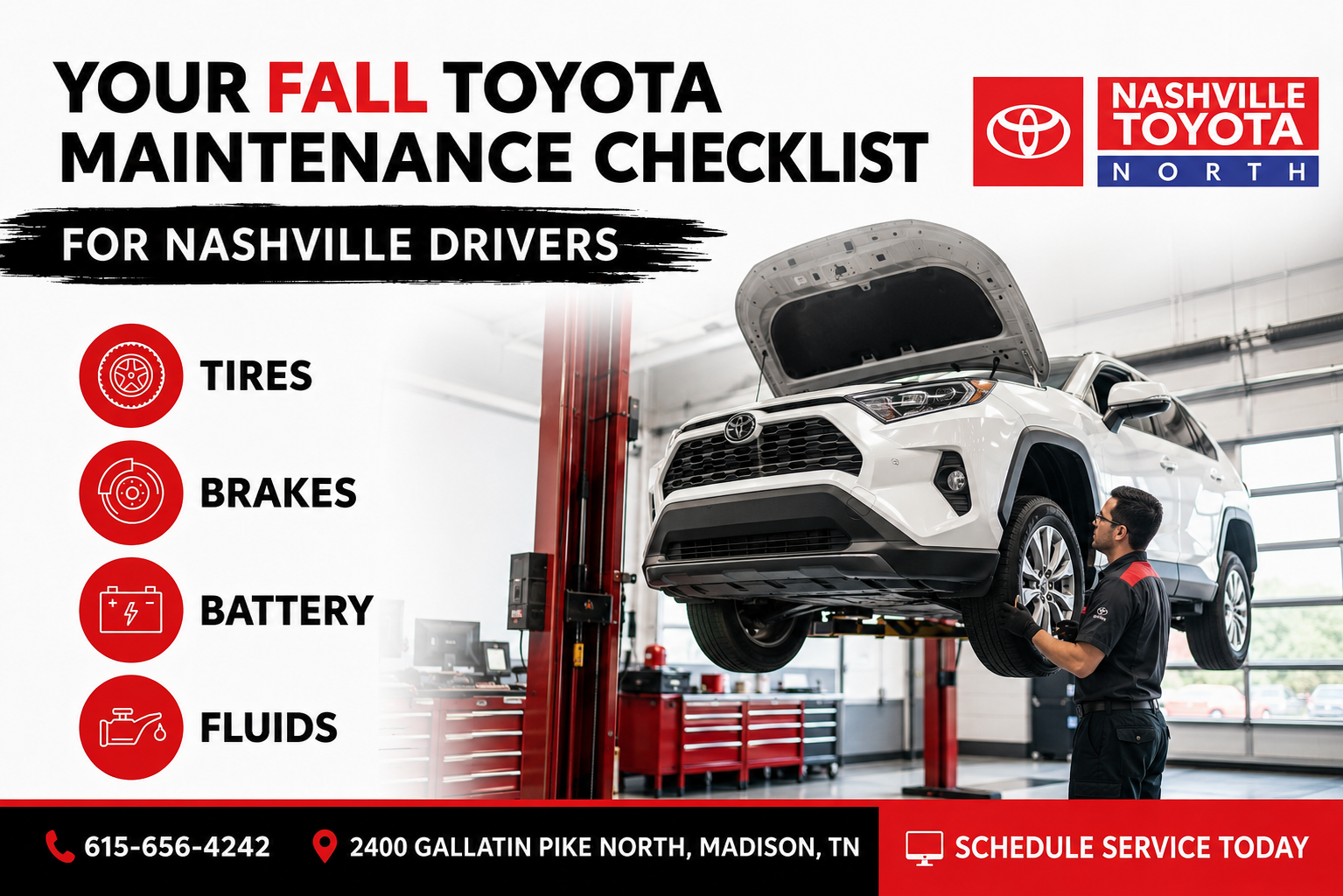
Toyota SUV being serviced by a technician for fall maintenance at a Nashville dealership

Your Toyota Fall Maintenance Checklist for Nashville Drivers

As late summer eases into fall across Middle Tennessee, the way you use your Toyota starts to shift. Morning commutes get a little cooler, football weekends fill up the calendar, and holiday road trips to see family are suddenly closer than they seem. This is the ideal window to get ahead of seasonal wear before the temperature drops. A little attention now helps your vehicle handle everything from a rainy drive on Gallatin Pike to a longer haul out of the greater Nashville area. Use this Toyota fall maintenance checklist to keep your car, truck, or SUV ready for the months ahead. Why Fall Is the Right Time for Toyota Maintenance in Nashville Middle Tennessee summers are hot and humid, and that heat is hard on a vehicle. By the time fall arrives, your battery, fluids, and rubber components have all put in a long, warm season of work. Cooler weather then introduces a new set of demands, including chilly starts, wet leaves, earlier sunsets, and the occasional cold snap that catches drivers off guard. Staying on top of maintenance as the seasons turn means small issues get caught before they grow. It also means fewer surprises when you are loading up for a weekend trip to the Smokies or heading north through Goodlettsville and Springfield for the holidays. Think of fall service as a reset that carries you comfortably into winter. Following Your Toyota Maintenance Schedule Every Toyota comes with a recommended maintenance schedule based on time and mileage, and that schedule exists for good reason. Following it helps protect performance, efficiency, and long-term reliability. Fall is a natural checkpoint to make sure you are current on oil changes, tire rotations, and inspections. If you have fallen a little behind over a busy summer, this is a great moment to catch up and start the cooler months on solid footing. Tires: Your First Line of Traction Your tires are the only part of your Toyota that actually touch the road, so they deserve early attention. Cooler air causes tire pressure to drop, and underinflated tires affect handling, braking, and fuel economy. Check your pressure as temperatures fall and adjust it to the level recommended for your vehicle. Tread depth matters just as much once fall rains arrive. Nashville sees plenty of wet pavement in autumn, and healthy tread helps channel water away so you keep your grip. Look for uneven wear, and consider a rotation if it has been a while, since even wear extends the life of the set. A technician can also check alignment if your Toyota has been pulling to one side. Brakes: Stopping Power for Wet Roads Fall means slick roads from rain and fallen leaves, which puts your braking system in the spotlight. If you have noticed any squealing, grinding, a soft pedal, or longer stopping distances, have your brakes inspected before the wet season is in full swing. Pads, rotors, and brake fluid all play a role in confident stopping. A thorough brake check gives you peace of mind on hilly neighborhood streets in Hendersonville and on busy stretches of interstate alike. Addressing brake wear early is almost always simpler than waiting until a small issue affects other components. Battery: Avoid the Cold-Weather Surprise Summer heat quietly wears down batteries, and the effects often show up when the first cold morning arrives. A battery that struggled through July may not have much left when temperatures dip. Fall is the smart time to test your battery's condition and check the terminals for corrosion. If your Toyota has been slow to start or your battery is a few years old, a proactive test can save you from an inconvenient no-start in a parking lot. Replacing a tired battery on your schedule is far more pleasant than doing it on a cold Rivergate morning when you are already running late. Fluids: The Lifeblood of Your Toyota Your vehicle relies on several fluids working together, and each one deserves a look as the seasons change. Key Fluids to Check This Fall Engine oil: Clean oil at the correct level protects your engine through temperature swings. If you are due for a change, fall is a natural time. Coolant and antifreeze: This fluid regulates engine temperature and protects against freezing when a cold snap hits Middle Tennessee. Brake fluid: Proper levels and condition support consistent braking performance. Transmission and power steering fluid: These keep your Toyota shifting and steering smoothly. Windshield washer fluid: Easy to overlook, yet essential for clearing grime, rain, and road spray. A technician can inspect these fluids, top off what is low, and flag anything that looks worn. Handling fluids together during one visit keeps your maintenance efficient and thorough. Wipers and Visibility: See and Be Seen Fall brings shorter days and more rain, so clear visibility becomes a daily priority. Wiper blades wear out gradually, and many drivers do not notice until a downpour reveals streaking or chattering. If your blades are leaving streaks or skipping across the glass, it is time for a fresh set. While you are focused on visibility, check that all your exterior lights are working, including headlights, taillights, brake lights, and turn signals. With sunset arriving earlier, working lights help you see the road and help other drivers see you on darker evenings around Madison and Mt. Juliet. HVAC: Comfortable Cabin, Clear Windows Your heating and defrost system moves from optional to essential as the air turns crisp. Test your heat now so you are not troubleshooting on the first cold morning. The defroster is especially important for clearing foggy or frosty windows quickly and safely before you pull out of the driveway. It is also a good time to consider your cabin air filter. A fresh filter supports airflow and helps keep the air inside your Toyota clean, which is a nice comfort upgrade heading into the season when windows stay closed. Trust Genuine Toyota Parts and Factory-Trained Technicians Seasonal maintenance is only as good as the parts and expertise behind it. At the Nashville Toyota North service center, your vehicle is cared for by factory-trained technicians who know Toyotas inside and out. They work with genuine Toyota parts that are designed specifically for your model, which supports proper fit and long-term reliability. A comprehensive visit can also include a multi-point inspection, giving you a clear picture of your Toyota's overall condition and any items worth watching. If you like to plan around value, it is always worth reviewing the current service and parts specials before your appointment so you know what savings may apply. Pricing varies by service and vehicle, so checking ahead helps you plan with confidence. If you want a sense of how a visit unfolds from check-in to completion, our guide on what to expect at a Toyota service center walks you through the experience step by step. Ready to Get Your Toyota Fall-Ready? Fall in Middle Tennessee moves quickly, and a little preparation now pays off through the cooler months and every road trip in between. Whether your Toyota needs a quick check or a full seasonal once-over, the service team at Nashville Toyota North is ready to help you drive with confidence. When it works for your schedule, you can schedule service online and get your vehicle set for the season ahead.

New Toyota at a Nashville dealership representing Toyota lease deals for local shoppers

Toyota Lease Deals Nashville | How to Compare Them

If you have been eyeing Toyota lease deals in Nashville, you have probably noticed that advertised offers can look very different from one another, and it is not always clear why. Leasing is a genuinely useful way to drive a new Toyota, but the numbers behind a lease can feel like a puzzle until you understand the pieces. This guide breaks down what actually makes up a lease, which factors shape a so called deal, how leasing compares to financing, and how to evaluate an advertised offer honestly. Keep in mind that specific terms and current offers change over time, so anything you see should be confirmed with the dealership before you decide. What Actually Makes Up a Toyota Lease A lease is a contract to drive a vehicle for a set period rather than to own it outright. Because you are paying to use the car over a defined term instead of buying it in full, the structure is built around a handful of core components. Understanding these makes every advertised offer easier to read. The Key Building Blocks Most Toyota leases are shaped by the same set of factors: Term length: the number of months the lease runs, often a set span such as two or three years. Mileage allowance: the total miles you are permitted to drive across the life of the lease. Vehicle value over the term: leases are structured around how much value the car is expected to hold, which influences your payment. Money factor: a figure that functions like the interest portion of the lease. Incentives: manufacturer or dealer offers that can change from month to month. Fees and due at signing amounts: any upfront costs and charges built into the agreement. When you look at these pieces together rather than fixating on a single number, the full picture of a lease comes into focus. You can review current leasing options (https://www.nashvilletoyotanorth.com/leasing-options.html) with the team at Nashville Toyota North to see how these components come together for the model you have in mind. The Deal Factors Worth Watching When people talk about a good lease, they are usually reacting to a mix of the elements above. Learning to read those factors helps you judge an offer on its merits instead of on the headline alone. Term and Mileage Term length and mileage allowance work hand in hand. A longer term or a higher mileage allowance changes the shape of the agreement, so the right combination depends on how much you actually drive. Before you compare offers, estimate your yearly mileage based on your commute across the metro area, your weekend trips, and any regular travel out toward Hendersonville or Springfield. Choosing an allowance that reflects your real habits helps you avoid surprises later, since going over the agreed mileage generally results in a per mile charge at lease end. The Money Factor The money factor is the part of a lease that behaves like interest. You do not need to master the math to shop wisely, but it helps to know that this figure influences your payment alongside the vehicle's value and the term. Asking the dealership to explain how the money factor applies to a given offer is a perfectly reasonable question, and a good team will walk you through it. Incentives That Change Over Time Manufacturer and dealer incentives can shift the look of a lease from one month to the next. That is exactly why an offer you saw a few weeks ago may not match what is available today. Rather than treating any single advertised figure as permanent, think of incentives as a moving piece that is best confirmed in real time. This is also why it is worth reaching out directly to check what is current for the model you want. Lease vs. Finance: Which Path Fits You One of the most common questions Nashville shoppers ask is whether to lease or finance. Both are legitimate ways to drive a new Toyota, and the better choice comes down to your priorities. When Leasing May Make Sense Leasing tends to appeal to drivers who like moving into a newer vehicle more often and who have fairly predictable driving patterns. Because you return the car at the end of the term, you can transition into a different Toyota when your lease wraps up rather than dealing with a private sale. Drivers who value the latest features and stay within a consistent mileage range often find leasing fits their lifestyle well. If you are new to the process, our step by step guide on how to lease a car for the first time (https://www.nashvilletoyotanorth.com/blogs/4569/how-to-lease-a-car-for-the-first-time-a-complete-step-by-step-guide) walks through what to expect from start to finish. When Financing May Make Sense Financing is a path toward ownership. You take out a loan, make payments over the term, and once the loan is paid off the vehicle is yours to keep with no mileage limits and no wear guidelines. If you tend to keep cars for many years, drive long distances, or like building toward something you own outright, financing may suit you better. Neither path is universally right. The best fit depends on how you drive and what you value. How to Evaluate an Advertised Lease Honestly Advertised lease offers can be genuinely useful starting points, but reading them well takes a little care. The goal is to understand the whole agreement rather than reacting to one eye catching number. Start by looking at the full set of terms together. A payment figure means little without the term length, the mileage allowance, any amount due at signing, and the fees that come with it. Two offers can look similar on the surface while being structured quite differently underneath. Ask what is included, what is required upfront, and how the mileage allowance lines up with your real driving. It also helps to remember that advertised offers are snapshots in time. Because incentives and terms change, the honest move is to confirm the current details directly with the dealership before you sign anything. A trustworthy dealership will be glad to explain each part of an offer in plain language and will never pressure you to rush. When every component is clear and matches your needs, you can move forward with confidence. A Quick Word on Timing and Availability Because Toyota lease deals in Nashville shift with the calendar, the smartest habit is to check what is current when you are actually ready to act. Availability of specific models can also vary, so it helps to confirm both the vehicle and the terms at the same time. There are no guaranteed outcomes with leasing, and any figure you compare should be treated as something to verify rather than assume. Approaching the process this way keeps your expectations grounded and your decision informed. Ready to Explore Your Toyota Lease Options? Understanding how a lease is built is the first step toward choosing the option that suits you best. If you have questions about terms, mileage, incentives, or whether leasing or financing fits your situation, the team at Nashville Toyota North is happy to help. When you are ready, reach out to confirm current offers or request a quote, and take the next step at your own pace.

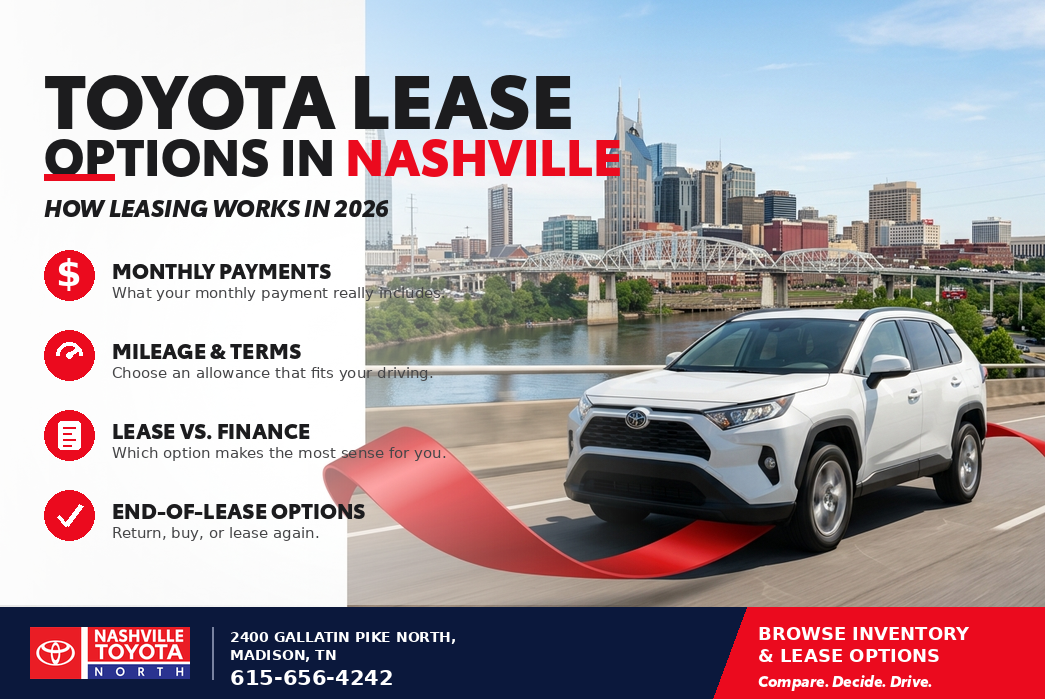
New Toyota parked at a Nashville dealership representing Toyota lease options

How Leasing a Toyota Works in Nashville: Terms, Mileage & What to Expect

If you have been weighing a Toyota lease in Nashville but are not sure how the process actually works, you are not alone. Leasing looks different from a traditional purchase, and understanding the terms up front makes it easier to decide whether it fits your driving habits and budget. This guide walks through the mechanics of how leasing a Toyota works, what a lease agreement typically covers, and what to expect from the day you sign to the day the lease ends. What Does It Mean to Lease a Toyota? When you lease a Toyota, you are paying to drive the vehicle for a set period of time rather than buying it outright. Think of it as a long-term agreement to use the car under agreed-upon conditions. At the end of the term, you return the vehicle, and from there you have several paths to choose from. Because you are not paying toward full ownership, a lease is structured around the vehicle’s expected value over the term rather than its entire cost. The agreement spells out how long you can keep the car, how many miles you can drive, and the condition it should be in when you bring it back. The Core Parts of a Lease Agreement Most Toyota lease agreements share a few common elements: Term length: the number of months the lease runs, commonly a set span such as two or three years. Mileage allowance: the total miles you are permitted to drive over the life of the lease. Condition expectations: guidelines for normal versus excess wear. End-of-lease options: what you can do when the term wraps up. Reviewing these details before you sign helps you match a lease to how you actually drive. You can explore current leasing options with the team at Nashville Toyota North to see how these pieces come together for the model you have in mind. Lease vs. Finance: How They Differ One of the most common questions Nashville shoppers ask is whether to lease or finance a Toyota. Both are legitimate ways to drive a new vehicle, and the right choice depends on your priorities. When Financing May Make Sense Financing is a path toward ownership. You take out a loan, make payments over the term, and once the loan is paid off, the vehicle is yours to keep with no mileage limits and no condition guidelines to worry about. If you tend to keep cars for many years, drive long distances, or like the idea of building toward an asset you own, financing may be the better fit. If you are comparing loan structures, our overview of dealer financing versus bank financing in Nashville breaks down how each works. When Leasing May Make Sense Leasing tends to appeal to drivers who like having a newer vehicle more often and who have fairly predictable driving patterns. Because you return the car at the end of the term, you can move into a different Toyota when your lease ends rather than dealing with a private sale or trade. Drivers who value the latest features and technology, and who stay within a consistent mileage range, often find leasing aligns well with their lifestyle. Understanding Mileage Limits Mileage is one of the defining features of any car lease in Nashville. Every lease includes an allowance, and staying within it is an important part of a smooth experience. Before you sign, it helps to estimate how much you drive in a typical year. Consider your commute across the metro area, weekend trips, and any regular travel. If you routinely rack up long distances, you can discuss a higher mileage allowance up front. If you drive less, a standard allowance may be plenty. Going over the agreed mileage generally results in a per-mile charge at the end of the term, so choosing an allowance that reflects your real habits is one of the smartest things you can do when you lease a Toyota. Wear and Tear: What to Expect Leases distinguish between normal wear and excess wear. Normal wear covers the ordinary signs of everyday driving, the kind of minor marks any vehicle picks up over time. Excess wear refers to damage beyond that baseline, such as significant dents, deep scratches, interior damage, or worn tires below acceptable limits. To keep things straightforward at lease-end, treat the vehicle with routine care. Keeping up with scheduled maintenance, addressing issues promptly, and keeping the interior clean all help ensure the car comes back in good shape. If you are unsure whether something counts as excess wear, the service and leasing teams can walk you through the guidelines well before your term ends. End-of-Lease Options As your lease term winds down, you generally have a few directions to consider: Return the vehicle and lease again: hand back your current Toyota and move into a new lease, often a popular choice for drivers who like staying in a newer model. Purchase the vehicle: many leases include the option to buy the car you have been driving. If you have grown attached to it, this can be a convenient route. Return and finance a different vehicle: bring back the leased Toyota and transition into a purchase, whether new or certified pre-owned. Knowing these options ahead of time makes the end of your lease feel less like a deadline and more like a decision point. Why Lease a Toyota in Nashville? Nashville’s mix of daily commuting, growing neighborhoods, and weekend getaways makes reliability and versatility valuable in a vehicle. Toyota’s lineup spans efficient sedans, family-friendly SUVs, capable trucks, and hybrids, so there is likely a model that fits how you move around the area. Leasing can be an approachable way to get behind the wheel of a new Toyota and enjoy up-to-date features while keeping your plans flexible. You can browse the current new inventory to see what is available, and review financing information if you want to compare paths. Ready to Learn More? Understanding how a lease works is the first step toward choosing the option that suits you best. If you have questions about terms, mileage, or which Toyota might be the right fit, the team at Nashville Toyota North is happy to help. When you are ready, you can schedule a test drive or reach out to explore your leasing options at your own pace.

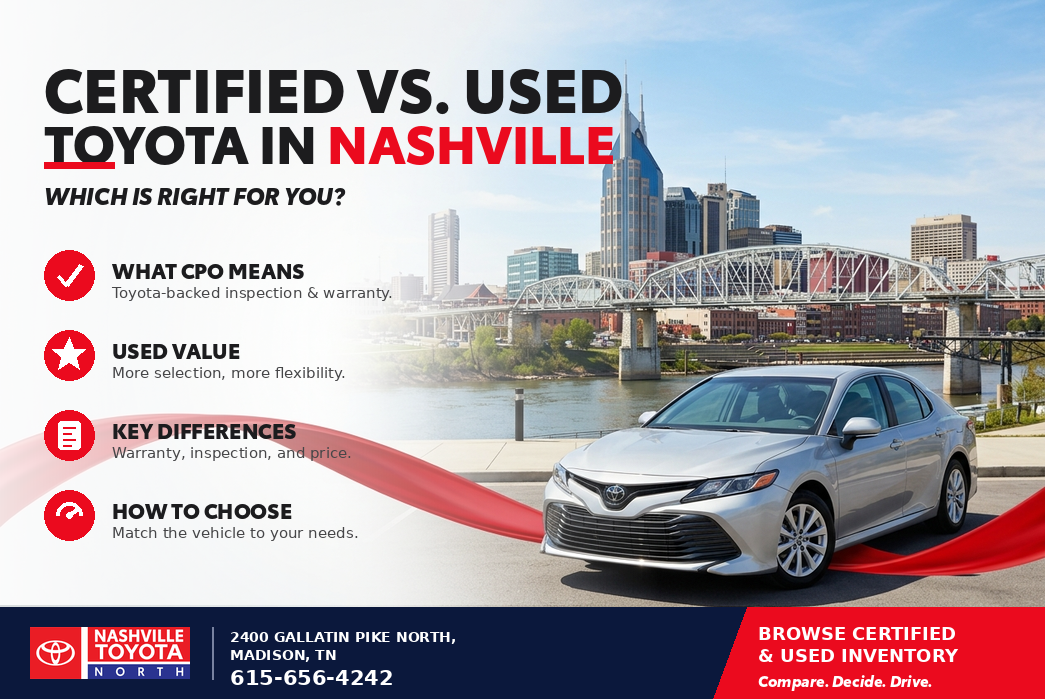
Certified pre-owned Toyota vehicles on display at a Nashville dealership

Certified Pre-Owned vs. Used Toyota: Which Is Right for a Nashville Buyer?

Shopping for your next Toyota in Nashville often comes down to one important fork in the road: should you buy a Certified Pre-Owned (CPO) Toyota or a regular used Toyota? Both can be smart, budget-friendly ways to get behind the wheel of a dependable vehicle, but they are not the same thing. Understanding how they differ, and which one fits your priorities, can help you shop with confidence. This guide breaks down what each option means, how they compare, and how to decide which is right for you. What “Certified Pre-Owned Toyota” Actually Means A certified pre-owned Toyota in Nashville is more than just a used car with a nicer label. Toyota runs an official program called Toyota Certified Used Vehicles (TCUV), and only vehicles that meet the manufacturer’s standards can carry that designation. The Toyota Certified Used Vehicles Program To become a CPO Toyota, a vehicle typically must fall within Toyota’s eligibility guidelines and pass a rigorous, manufacturer-defined inspection performed by trained technicians. Here is what the program generally includes: A comprehensive multi-point inspection. Certified vehicles are examined across mechanical, safety, and cosmetic areas, and reconditioned as needed to meet Toyota’s certification standards. Manufacturer-backed warranty coverage. CPO Toyotas come with limited warranty coverage backed by Toyota itself, which is one of the biggest differences between a certified vehicle and a standard used car. For the exact terms, coverage lengths, and what is included, ask our team so you get current, accurate details. Vehicle history transparency. Certified vehicles include a vehicle history report, giving you insight into the car’s background before you buy. Because the certification comes directly from Toyota, a CPO vehicle offers an added layer of reassurance for shoppers who want a used car that has been vetted to the automaker’s specifications. What a Regular Used Toyota Means A standard used Toyota is simply a pre-owned vehicle offered for sale without the formal Toyota certification. That does not mean it is a lesser car. Many used Toyotas are well-maintained, low-mileage vehicles that offer excellent value. How Used Toyotas Are Evaluated At a reputable dealership, used vehicles still go through an inspection process before they are offered for sale. The key distinction is that a non-certified used Toyota does not carry the specific manufacturer-backed certification, its associated warranty coverage, or the standardized TCUV inspection. Used inventory also tends to be more varied: you may find a wider range of model years, mileage levels, trims, and even non-Toyota brands taken in on trade. You can browse the full range of options anytime through our used Toyota inventory in Nashville, which is a great way to see what is currently available. Key Differences Between CPO and Used Toyotas When you compare the two side by side, a few core differences stand out: Certification: CPO Toyotas meet Toyota’s official certification standards; standard used vehicles do not carry that designation. Warranty: CPO vehicles include manufacturer-backed warranty coverage, while used vehicles are typically sold with more limited or as-is terms (ask us about specifics on any given vehicle). Inspection standards: CPO vehicles undergo Toyota’s standardized inspection and reconditioning process. Used vehicles are inspected, but not to that formal, manufacturer-defined program. Selection: Used inventory often offers broader variety in age, mileage, and price points, while CPO vehicles concentrate on newer, lower-mileage models that qualify for the program. Peace of mind vs. flexibility: CPO leans toward added reassurance; used leans toward flexibility and a wider field of choices. Who Each Option Is Best For There is no single “right” answer here. The best choice depends on what matters most to you. A CPO Toyota May Be Right If You Want Added confidence from a manufacturer-backed vehicle Warranty coverage that goes beyond a typical used-car sale A newer, lower-mileage Toyota that has been inspected to Toyota’s standards A more predictable ownership experience, especially if this is your primary vehicle A Used Toyota May Be Right If You Want The widest possible range of choices, including older model years Flexibility to explore different trims, mileage levels, and budgets A dependable second vehicle, a first car for a new driver, or a practical commuter The chance to consider trade-in vehicles from other brands alongside Toyotas How to Decide as a Nashville Buyer Choosing between a CPO and a used Toyota is easier when you weigh a few practical questions: How long do you plan to keep the vehicle? If you want to drive it for many years, the added warranty coverage of a CPO Toyota may appeal to you. For a shorter-term or budget-focused purchase, a used vehicle can make a lot of sense. How important is manufacturer backing? If added reassurance and Toyota-standard inspection are priorities, lean CPO. If flexibility and selection matter more, explore used. What is your driving situation? Daily highway commuters around Nashville, growing families, and first-time buyers all have different needs, and either path can serve them well. Are you also open to a new Toyota? Some shoppers start out considering used vehicles and realize a new model fits their needs. It never hurts to compare against the new Toyota inventory in Nashville before deciding. It also helps to think about long-term dependability. If reliability is high on your list, our guide to the most reliable Toyota models can help you narrow down which vehicles tend to hold up well over time, whether you buy certified or used. Buying a CPO or Used Toyota in Nashville Whichever direction you lean, the buying process is smoother when you work with a franchise Toyota dealership that knows the brand inside and out. Our team can walk you through the differences between a specific certified vehicle and a comparable used one, explain the exact warranty and certification details on any car you are considering, and help you match a vehicle to your budget and driving needs. The Bottom Line A Certified Pre-Owned Toyota offers manufacturer-backed reassurance and standardized inspection, while a used Toyota offers broader selection and flexibility. Both can be excellent choices for Nashville-area drivers. The right pick simply depends on your priorities, timeline, and how you plan to use the vehicle. Ready to see the difference for yourself? Schedule a test drive or contact our team at Nashville Toyota North, and we will help you find the Toyota that fits your life best. Blog metadata (for WordPress entry) Focus keyword: certified pre-owned toyota nashville SEO title (<=60 chars): Certified Pre-Owned vs. Used Toyota in Nashville Open Graph Title (<=60 chars): CPO vs. Used Toyota: Which Is Right for You? Open Graph Description (<=155 chars): Compare Certified Pre-Owned and used Toyotas in Nashville. Learn the key differences and which option fits your budget, needs, and driving plans. Featured image (1045 x 699): 2-cpo-vs-used-toyota-nashville.png Featured image alt text: Certified pre-owned Toyota vehicles on display at a Nashville dealership Featured image title: Certified Pre-Owned vs. Used Toyota in Nashville Featured image caption: Comparing Certified Pre-Owned and used Toyotas at Nashville Toyota North. Featured image description: A lineup of Toyota vehicles at Nashville Toyota North, illustrating the choice between a Certified Pre-Owned Toyota and a regular used Toyota for Nashville-area buyers.

Toyota dealer serving Madison and Mt. Juliet TN with new and used Toyota vehicles on the lot

Toyota Dealer Near Madison & Mt. Juliet: What to Know Before You Visit

Shopping for a vehicle is easier when the dealership is close to home, familiar with your area, and ready to help however you like to shop. If you live in the Nashville suburbs and you have been searching for a Toyota dealer in Madison, TN, or a Toyota dealer near Mt. Juliet, Nashville Toyota North is a short drive away and set up to make every part of the process simple. This guide walks through what local buyers should know before they visit, from browsing new and used inventory to service, parts, and what to bring on the day you stop by. Why Local Buyers Choose a Nearby Toyota Dealership For drivers in Madison and Mt. Juliet, a nearby Toyota dealer means less time on the road and more time actually looking at vehicles. Convenience matters when you are balancing work, family, and everything in between, and having a dealership close to home makes test drives, service appointments, and quick questions far more manageable. Convenience for suburb drivers Both Madison and Mt. Juliet sit within easy reach of Nashville Toyota North, so you can plan a visit around your schedule instead of building your day around a long trip across town. Whether you are coming in on a weekday evening or a weekend morning, a closer dealership keeps the whole experience low-stress. One team for buying, servicing, and support Choosing a local dealership is not just about the day you buy. It is about the relationship afterward. When you shop close to home, the same team that helps you find your Toyota can also handle routine maintenance, warranty service, genuine parts, and future upgrades. That continuity is one of the biggest reasons local buyers return to the same dealership for years. New and Used Toyota Shopping Nashville Toyota North carries the full lineup of new Toyota vehicles along with a rotating selection of pre-owned options, so you can compare choices side by side and decide what fits your needs. Exploring new Toyota models If you are after the latest technology, the newest safety features, and full factory warranty coverage, a new Toyota may be the right path. You can browse the current lineup and check availability anytime on the new Toyota inventory page. Popular choices among Nashville-area drivers include versatile SUVs, dependable sedans, capable trucks, and fuel-efficient hybrids, and the team can walk you through trims and features so you understand your options before you commit. Considering certified pre-owned and used vehicles Not everyone wants a brand-new vehicle, and that is perfectly fine. A certified pre-owned or quality used Toyota can be a smart way to get a reliable vehicle. Certified pre-owned Toyotas go through a manufacturer inspection process and can include added benefits, while other used vehicles offer additional variety. The team can help you weigh new versus used based on how you drive, what you need, and what matters most to you. Financing questions, answered Financing can feel like the most confusing part of buying a car, but it does not have to be. The finance team can explain how the process works, what documents are helpful, and how to move forward at a pace that feels comfortable. Bringing your questions to the dealership is often the easiest way to get clear, personalized answers. Service and Parts for Everyday Drivers Buying the vehicle is only the beginning. Keeping it running well is where a nearby Toyota dealer really earns its value for Madison and Mt. Juliet drivers. Routine maintenance close to home Oil changes, tire rotations, brake checks, battery testing, and multi-point inspections are all part of keeping your Toyota dependable for the long haul. Having a service center nearby means you can keep up with recommended maintenance without rearranging your whole day. Factory-trained technicians know Toyota vehicles specifically, which helps them spot what needs attention and keep your vehicle performing the way it should. If you like to plan ahead, you can also learn how to make routine care more budget-friendly in this related guide: Toyota service coupons in Nashville: how to save on oil changes, brakes, and tires. Genuine Toyota parts and accessories When a component needs replacing or you want to add an accessory, genuine Toyota parts are designed specifically for your vehicle. The parts team can help you find the right fit, whether you are handling a project yourself or having the service department take care of it. Using parts built for your model helps maintain the quality and reliability you expect from a Toyota. What to Bring and Expect on Your Visit A little preparation makes any dealership visit smoother. Here is what tends to help. A valid driver’s license if you plan to test drive. Details about any vehicle you might trade in, such as the make, model, and mileage. A general sense of your must-have features and how you use your vehicle day to day. Any questions about models, financing, or service so nothing gets overlooked. When you arrive, expect a no-pressure conversation. A good visit starts with understanding what you need, then narrowing down options from there. You are welcome to look, ask questions, take a test drive, and take your time. There is no obligation to decide on the spot. Serving Madison and Mt. Juliet Nashville Toyota North is proud to serve drivers throughout the north Nashville area, including these two growing suburbs. If you are starting your search from Madison, the Toyota dealer for Madison, TN page is a helpful place to begin. If you are coming from the other direction, the Toyota dealer for Mt. Juliet page covers what to expect. Either way, you will find a team that understands local drivers and is ready to help you find the right Toyota. Ready When You Are Finding the right vehicle should feel straightforward, and having a Nashville Toyota dealer close to Madison and Mt. Juliet makes it easier to shop, service, and stay on the road with confidence. When you are ready to take the next step, schedule a test drive or contact the team and let us help you find a Toyota that fits your life.

Toyota shopper reviewing auto loan and financing options in Nashville

Toyota Financing in Nashville: Dealer vs. Bank, and How to Prepare

Buying a Toyota is exciting, but figuring out how to pay for it can feel like the harder part of the decision. Should you finance through the dealership or line up a loan at your own bank first? What do lenders actually look at, and how can you walk in ready? If you are a Nashville-area shopper getting close to a purchase, understanding your car financing options ahead of time can make the whole process calmer and clearer. This guide breaks down how Toyota financing in Nashville generally works, how dealer and bank financing compare, and the practical steps you can take before you ever sit down to sign. How Toyota Financing in Nashville Works At its core, financing a vehicle means borrowing money to buy the car now and repaying it over time in monthly installments. An auto loan is secured by the vehicle itself, which is one reason car loans are so widely available. When you finance at a dealership, the dealer works with lending partners on your behalf. In Toyota’s case, that often includes Toyota Financial Services (TFS), the captive lender associated with the brand, as well as banks and credit unions the dealership partners with. You complete a credit application, and the dealership submits it to potential lenders to find a loan offer that fits your situation. The role of Toyota Financial Services Because Toyota Financial Services is tied directly to the manufacturer, it frequently supports promotional programs on eligible new Toyota models. Availability and terms vary by model, credit profile, and timing, so the right move is to ask the finance team what current programs you may qualify for rather than assuming. You can start that conversation through the Nashville Toyota North finance page, which lets you begin the process online before visiting. Dealer Financing vs. Bank Financing One of the most common questions shoppers ask is whether to finance through the dealer or arrange a loan through their own bank. Both are legitimate paths, and each has strengths. Financing through the dealership Dealer financing is convenient because the application and the purchase happen in one place. Since the dealership submits your application to multiple lending partners, it can compare several potential offers at once, which may surface options you would not have found on your own. Manufacturer-supported programs through Toyota Financial Services are also generally accessed this way, so dealer financing is often where brand-specific opportunities live. Financing through a bank or credit union Getting pre-approved through your own bank or a local Nashville credit union before you shop gives you a reference point. You arrive knowing roughly what a lender is willing to offer, which can make comparing the dealership’s offer more straightforward. Some buyers value the existing relationship they have with their credit union, while others simply like having a number in hand. Which is right for you? There is no single correct answer. Many buyers do both: they get pre-approved at a bank or credit union, then let the dealership try to match or improve on it. Comparing offers side by side is the goal, and having more than one option only strengthens your position. For a deeper look at this comparison, our related post, Toyota Auto Loans Explained: Dealer Financing vs. Bank Financing in Nashville, walks through the trade-offs in more detail. What to Prepare Before You Apply A little preparation goes a long way toward a smoother auto loan experience. Here is what tends to matter most. Understand your credit Lenders review your credit history to help determine the terms they can offer. Before applying, it is worth checking your credit report so you know where you stand and can correct any errors. You do not need a perfect profile to explore financing, but knowing your situation helps you set realistic expectations and ask better questions. Think through your down payment A down payment is the amount you pay upfront toward the vehicle. Putting money down reduces the amount you need to borrow, which in turn affects your monthly payment and the total you repay over the life of the loan. Even a modest down payment can be meaningful. Consider what you can comfortably contribute without stretching your budget. Gather your documents Having paperwork ready speeds things up. Lenders commonly ask for proof of income, proof of residence, a valid driver’s license, and insurance information. If you are trading in a vehicle, bring its title or loan details as well. Consider special circumstances Buyers who are early in their credit journey, rebuilding, or facing other challenges still have paths forward. Nashville Toyota North offers a special financing option designed to help more shoppers explore what may be possible. Submitting an inquiry does not obligate you to anything; it simply opens a conversation. Understanding Your Loan Terms Once you receive an offer, a few key terms shape what your car financing will look like day to day. Loan term is the length of time you have to repay. A longer term generally lowers the monthly payment but increases the total interest paid over time; a shorter term does the opposite. Interest rate and APR reflect the cost of borrowing. Your rate depends on factors such as your credit profile, the loan term, and current lending conditions. Monthly payment is what you pay each month, shaped by the amount financed, the term, the rate, and your down payment. The healthiest way to think about it is as a balance: term, down payment, and rate all work together, and the right combination is the one that fits your monthly budget and your longer-term goals. Financing at the Dealership in Nashville When you are ready, the finance team at Nashville Toyota North can walk you through your options, answer questions, and help you understand each offer before you decide. There is no pressure to commit simply because you started an application, and asking questions is always encouraged. Ready to Take the Next Step? Preparing ahead of time turns Toyota financing in Nashville from a stressful unknown into a straightforward part of buying your next vehicle. When you feel ready, explore the new inventory to find the Toyota that fits you, or reach out to the finance team to start the conversation. We are here to help you move forward with confidence.