


Blog / Madison Toyota Dealer

Certified Pre-Owned Toyota in Nashville: What “Certified” Actually Gets You

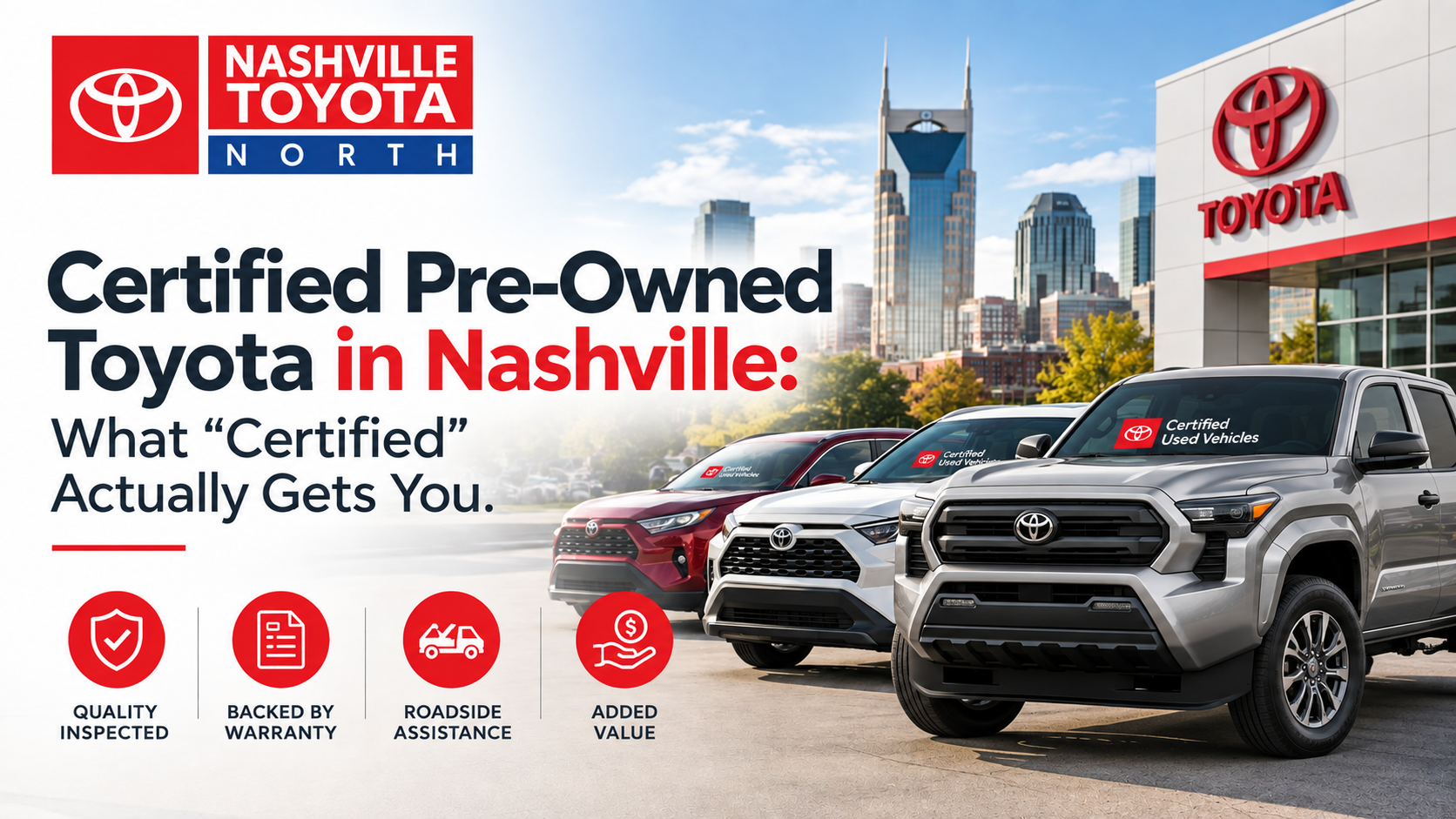
Certified Pre Owned Toyota Tacoma and SUVs at Nashville Toyota North, highlighting inspection, warranty, roadside assistance, and added value.

“Certified” is one of the most overused words in the car business. Plenty of vehicles get advertised as certified when all that really happened was a shop check and a dealer’s own promise. So when a Nashville shopper asks what a Certified Pre-Owned Toyota actually gets them, the honest answer starts with a distinction: there is a difference between a car a dealership calls certified and a car that carries Toyota Certified Used Vehicles status, which is a manufacturer program with published requirements and factory-backed coverage.

This guide covers what Toyota’s certification includes, how the program’s two tiers differ, how a certified Toyota compares to an ordinary used car and to a brand new one, who the program genuinely makes sense for, and what to verify before you sign anything.

What “Toyota Certified” means

Toyota Certified Used Vehicles is Toyota’s own program, not a dealer-created label. A vehicle has to meet Toyota’s eligibility rules on age and mileage, pass a required inspection, be reconditioned to program standards, and come with a CARFAX Vehicle History Report. Once it qualifies, the coverage that follows is backed by Toyota and honored at Toyota dealerships, not just at the store that sold it.

That last point matters more than most people realize. A dealer-certified car ties your coverage to one business. Factory certification travels.

Toyota runs two certified tiers, and they are not the same

This is the single most important thing to understand, and it is where most shoppers get tripped up. Toyota’s certified program has two levels, Gold Certified and Silver Certified, and the terms differ meaningfully between them. If someone tells you a Toyota is “certified” without telling you which tier, you do not yet have enough information.

Gold Certified

Gold is the tier most people picture when they think of Toyota CPO. According to Toyota’s certified program brochure, these vehicles receive a 160-point Quality Assurance Inspection, and hybrids get a 174-point inspection, which adds 14 checks specific to hybrid systems.

Coverage on Gold Certified vehicles, per Toyota, includes:

  • A 12-month/12,000-mile Limited Comprehensive Warranty with a $0 deductible
  • A 7-year/100,000-mile Limited Powertrain Warranty with a $0 deductible
  • 7-year/100,000-mile Roadside Assistance

Toyota’s newsroom describes Gold Certified eligibility as vehicles up to 6 model years old with no more than 85,000 miles.

Silver Certified

Silver is the newer, broader tier, and it exists to bring older and higher-mileage Toyotas into the certified program. Toyota’s newsroom describes Silver Certified vehicles as up to 10 model years old, generally in the 60,000 to 125,000 mile range, receiving a 136-point minimum quality assurance inspection.

Silver’s coverage is shorter. Toyota’s warranty page lists Silver Certified as carrying a 12-month/12,000-mile Limited Powertrain Warranty, alongside the same 12-month/12,000-mile Limited Comprehensive Warranty, with roadside assistance running 12 months/12,000 miles.

So both tiers give you a factory inspection, a vehicle history report, comprehensive coverage for the first year, and roadside help. The powertrain and roadside terms are where Gold and Silver diverge sharply.

One nuance worth reading twice

Toyota’s published terms describe the Gold powertrain coverage as 7 years or 100,000 total vehicle miles. “Total vehicle miles” refers to the odometer reading, not miles you personally add after buying. On a vehicle that already shows 70,000 miles, the mileage side of that warranty has considerably less runway than the headline number suggests. The time side and the mileage side both apply, and whichever arrives first ends the coverage.

Toyota also notes the powertrain coverage is transferable at no cost if you sell the vehicle before it expires, which is a real resale advantage.

What the inspection actually covers

An inspection point count is a marketing number on its own. What makes it useful is knowing that Toyota specifies what has to be checked and what has to be corrected before a vehicle can be certified. The inspection covers mechanical systems, the drivetrain, brakes, steering and suspension, electrical and electronics, the interior and exterior condition, tires, and on hybrids, the hybrid-specific components that a general-purpose used car inspection would not touch.

The practical value is not the number. It is that a technician working from a manufacturer checklist has to bring the vehicle up to a defined standard, and that a CARFAX report has to be part of the file. You are buying a documented process, not a handshake.

On hybrids specifically, Toyota’s brochure notes an 8-year/100,000-mile Factory Hybrid Vehicle Battery Warranty, and a 10-year/150,000-mile hybrid battery warranty for 2020 and later model years. If you are considering a certified RAV4 Hybrid, Camry Hybrid, or Prius, that factory battery coverage is a separate thing from the certified warranty and is worth confirming on the specific vehicle.

CPO versus a regular used Toyota

Here is the honest comparison.

A regular used Toyota is typically sold as is or with whatever is left of the original factory warranty. There is no required manufacturer inspection, no required reconditioning standard, and no added factory-backed coverage. The upside is flexibility: the used market includes vehicles that would never qualify for certification, including higher-mileage cars, older model years, and non-Toyota trade-ins.

A certified Toyota narrows the field to vehicles that cleared Toyota’s bar, then attaches coverage on top. You are trading selection breadth for verification and warranty.

Neither is automatically the right call. If you are the kind of buyer who will get an independent pre-purchase inspection, has a mechanic you trust, and is comfortable absorbing a repair, a well-chosen non-certified used Toyota can be an excellent vehicle. If you would rather not carry that risk, certification is doing real work for you. You can compare both sides directly on our used vehicle search, where certified vehicles can be filtered separately from the rest.

CPO versus new

A new Toyota gives you the full factory warranty from mile zero, the current model year’s features and safety technology, your exact choice of trim and color if you are willing to wait or order, and no prior owner history to evaluate.

A certified Toyota gives you a vehicle that has already absorbed its steepest depreciation, with a documented history and factory-backed coverage that closes much of the peace-of-mind gap. What you give up is time and miles already on the clock, a shorter coverage runway than a new car’s, and the constraint of choosing from vehicles that exist rather than configuring one.

The comparison gets more interesting on Gold Certified vehicles, because a 7-year/100,000-mile powertrain term on a relatively recent Toyota can be a genuinely long horizon. On a Silver Certified vehicle at 12 months/12,000 miles, the coverage is real but modest, and the decision looks more like a normal used car purchase with a safety net attached.

Who certified pre-owned actually makes sense for

Certification tends to be a strong fit if you:

  • Want a recent Toyota without buying the newest model year
  • Plan to keep the vehicle long enough that powertrain coverage matters
  • Are buying a hybrid and want the hybrid-specific inspection points and battery coverage confirmed
  • Do not have a trusted independent mechanic and would rather rely on a documented factory process
  • Value the transferability of coverage because you expect to sell in a few years

Certification tends to matter less if you:

  • Are shopping for an older or higher-mileage vehicle that falls outside program eligibility anyway
  • Are buying a non-Toyota trade-in, which cannot be Toyota Certified regardless of condition
  • Already plan an independent inspection and are comfortable managing repair risk yourself
  • Expect to sell or trade within a very short window

What to check before you buy

Bring this list with you.

1. Ask which tier. Gold or Silver. Get it in writing. The powertrain and roadside terms differ substantially, and “certified” alone does not tell you which you are getting.

2. Confirm it is Toyota Certified, not dealer certified. These are different products with different backing. Ask to see the certification paperwork.

3. Read the odometer against the warranty. Gold powertrain coverage is stated in total vehicle miles. Do the subtraction on the actual car before you assume you have the full 100,000.

4. Read the CARFAX yourself. Do not accept a summary. Look at ownership count, title history, accident records, and whether service intervals were kept.

5. Ask for the completed inspection documentation. A certified vehicle went through a defined checklist. Ask what was found and what was replaced or repaired.

6. Check hybrid battery coverage separately. If it is a hybrid, confirm the model year and the applicable battery warranty terms on that specific vehicle.

7. Confirm what is excluded. Every warranty has exclusions and conditions. Read them before, not after.

8. Verify remaining factory coverage. On a newer certified vehicle, some original factory warranty may still be in force alongside the certified coverage.

9. Test drive it like you mean it. Highway speed, rough pavement, full braking, every electronic feature, the climate system, and the infotainment.

10. Understand the financing separately from the car. Terms, rate, and length are their own decision. Our financing page is a reasonable place to start sorting that out before you are sitting at a desk.

The short version

Toyota Certified Used Vehicles is a real manufacturer program with published standards, and it delivers something a generic “certified” label does not: a required inspection, a required vehicle history report, and factory-backed coverage honored across Toyota dealerships. The catch is that the program has two tiers with meaningfully different terms, and the difference between Gold and Silver is the first question you should ask about any certified Toyota you are considering.

If you want to look at what certification covers in more detail, our certified pre-owned page breaks down the program, and the team at Nashville Toyota North can walk you through the tier, the inspection record, and the history report on any certified vehicle you are considering.


Posted in:

Related Posts

2026 Toyota hybrid models in Nashville, including a Grand Highlander, Prius, and Tacoma, highlighting ownership costs and fuel savings.

Which 2026 Toyotas Are Hybrid, and What They Actually Cost to Own in Nashville

Walk into any Toyota showroom in Middle Tennessee and you will hear the same three questions, usually in the same order. People do not open with horsepower. They open with the things that worry them. Do I have to plug it in? What happens when the battery dies? And does any of this matter if I spend my life on I-65? Those are good questions. Here are honest answers, followed by a plain list of which 2026 Toyota models actually offer a hybrid powertrain. 1. Do I have to plug it in? For a conventional hybrid, no. Not ever. Not once. This is the single biggest misunderstanding about hybrids, and it keeps people from even test driving one. A Toyota hybrid has a gas engine, an electric motor, and a battery, and the car manages all three on its own. Toyota puts it about as simply as it can be put: hybrid electric vehicles “don’t use a plug to charge their battery. Instead, they recycle the kinetic energy captured from the vehicle’s braking motion to recharge on their own.” That is what regenerative braking means. Every time you lift off the accelerator or slow down for the light at Gallatin Pike, the electric motor works backward as a generator and puts energy back into the battery. Stop and go traffic, which is the worst thing that can happen to a normal gas engine, is actually where a hybrid gets its best work done. You never think about it. You put gas in it. That is the whole routine. Toyota describes the ownership experience the same way: hybrid electric vehicles “start, refuel and handle like the gas-only Toyotas you already know and love.” A plug-in hybrid is a different animal. A plug-in hybrid, which Toyota labels clearly in the model name, carries a larger battery that you can charge from an outlet or a charging station. That lets it drive on electricity alone for a stretch before the gas engine takes over. Once that charge is used up, it simply operates as a hybrid and keeps going on gas. You can drive a plug-in hybrid without ever charging it. You just would not be getting the benefit you paid for. So the rule of thumb is easy. If the name says Plug-in Hybrid, you can plug it in. If it just says Hybrid, there is no plug and no cord and no decision to make. 2. Does the battery die, and what happens if it does? Batteries are wear items. Everything in a car is a wear item. The real question is how long, and who pays. Toyota covers the hybrid battery in these vehicles with a 10 year or 150,000 mile limited warranty, whichever comes first. That is on top of the coverage for the rest of the hybrid system. Looking at the official 2026 warranty and maintenance guide for the Grand Highlander Hybrid, the other hybrid-related components, things like the battery control module, the hybrid control module, and the inverter with converter, carry 8 year or 100,000 mile coverage from the vehicle’s in-service date. Read those numbers again, because they are the answer to the anxiety. A hybrid battery is not a mystery box with a short fuse on it. It is a covered component with a longer warranty term than most of the car around it. A few practical points for Nashville owners: Heat and cold both matter, and neither is extreme here. Middle Tennessee summers are humid but our climate is nowhere near the punishing desert heat that battery packs dislike most. Toyota’s hybrid batteries are actively managed and cooled by the vehicle, not left to fend for themselves. Degradation is gradual, not sudden. A hybrid battery does not go from fine to dead overnight. Capacity fades slowly, and the car keeps operating as a hybrid while it does. Service is normal service. Hybrid systems are diagnosed and maintained by trained technicians using Toyota procedures. If you want a straight answer about your specific vehicle, our service center can inspect the hybrid system and tell you what it sees. The honest caveat: no warranty covers everything forever, terms have conditions, and coverage details vary by model and by how the vehicle has been maintained. Read the warranty guide for the specific vehicle you are considering. It is published by Toyota and it is not hard to follow. 3. Is a hybrid still worth it if I mostly drive highway? This is the sharpest question of the three, and it deserves a real answer instead of a sales pitch. A hybrid’s biggest advantage shows up in stop and go driving. That is where regenerative braking captures the most energy and where the electric motor does the most work while the gas engine rests. If your commute is Hillsboro Village to downtown, you are in the ideal case. At a steady 70 miles per hour on I-40, the gas engine is doing most of the propelling, and the efficiency gap between a hybrid and a comparable gas model narrows. That is simply how the technology works, and any dealer who tells you otherwise is not being straight with you. But “narrows” is not “disappears,” and three things are worth weighing: Almost nobody drives only highway. Nashville traffic being what it is, even a highway commuter spends real time crawling on the ramp at Briley Parkway or sitting through the merge at the 440 interchange. Those are exactly the conditions where the hybrid pays you back. Your actual fuel cost depends on your actual driving mix, so be honest with yourself about what your week really looks like. Hybrids are not slower. This is a leftover reputation from twenty years ago. The 2026 4Runner offers an i-FORCE MAX Hybrid rated at up to 326 horsepower and 465 lb.-ft. of torque, which is more of both than its non-hybrid i-FORCE engine. The Grand Highlander offers a Hybrid MAX powertrain positioned by Toyota for power and performance, not just efficiency. The electric motor’s instant torque is genuinely useful when you are merging. Traction can come with the package. On several models, all-wheel drive is part of the hybrid setup. Every 2026 Corolla Cross Hybrid, for example, comes with Electronic On-Demand All-Wheel Drive as standard equipment. That is a nice thing to have on the two or three genuinely ugly winter mornings Nashville gets each year. Which 2026 Toyota models offer a hybrid powertrain Based on Toyota’s own 2026 model information, here is where hybrid and plug-in hybrid powertrains show up in the lineup. Hybrid (no plug required): Camry Corolla Hybrid Corolla Cross Hybrid Prius Sienna Highlander Hybrid Grand Highlander Hybrid, including the Hybrid MAX powertrain RAV4 Hybrid 4Runner, with the available i-FORCE MAX Hybrid Crown and Crown Signia Sequoia Tacoma and Tundra, with available hybrid powertrains Plug-in Hybrid (you can charge it): Prius Plug-in Hybrid RAV4 Plug-in Hybrid A note on how Toyota names things. Several nameplates exist in both gas and hybrid form, and Toyota distinguishes them right in the model name. Highlander and Highlander Hybrid are listed separately. So are Grand Highlander and Grand Highlander Hybrid, Corolla Cross and Corolla Cross Hybrid, and RAV4, RAV4 Hybrid, and RAV4 Plug-in Hybrid. If the word Hybrid is in the name, the hybrid system is in the car. One thing we are not going to tell you You will see plenty of articles quoting a specific federal or state tax credit amount for hybrids and plug-in hybrids. We are not going to do that, because those rules change, eligibility depends on the vehicle and on your personal tax situation, and a number that was accurate last year can be wrong today. If incentives matter to your decision, confirm current federal and Tennessee eligibility with the official sources and with your tax advisor before you sign anything. The short version If the name does not say Plug-in, you never plug it in. The hybrid battery carries a 10 year or 150,000 mile limited warranty. And highway driving narrows the hybrid advantage without erasing it, especially in a city where nobody’s commute is really all highway. Come drive one. That answers more questions in fifteen minutes than any article will.

Toyota RAV4 and Toyota Highlander with the Nashville skyline, comparing family friendly SUV options at Nashville Toyota North.

Toyota RAV4 vs Toyota Highlander: Which SUV Fits Your Nashville Family?

Two families walk into a Toyota showroom with nearly identical needs, and they drive home in different SUVs. That is not a sales trick. The RAV4 and the Highlander are both excellent, and they are built for different lives. The trick is knowing which life is yours before you start comparing feature lists. Here is a simple way to think it through. Start With One Question: Do You Need a Third Row? Almost every RAV4 versus Highlander decision comes down to this, and it is worth answering honestly before anything else. The Highlander offers a third row. Toyota builds it with 7 passenger seating using second row captain’s chairs, or 8 passenger seating when you choose the second row bench. The RAV4 does not offer a third row at all. That sounds like a simple yes or no, but the honest version is a little more nuanced. Ask yourself how often you actually carry more than five people. If the answer is “every single weekday, because I drive the carpool,” the Highlander is doing real work for you. If the answer is “twice a year when the cousins visit,” you may be buying a third row that mostly sits folded flat. Plenty of Nashville families land in the middle. You have two kids now, but you also have grandparents in Hendersonville who ride along on Sunday afternoons, and you host the postgame crew after middle school football. If the third row is your relief valve for those weeks, it earns its keep. If it is insurance against a maybe, keep reading. Cargo Space and the Reality of Parking Here Here is where Nashville itself starts voting. The RAV4 is the smaller vehicle, and smaller matters more in this city than the spec sheet suggests. Think about the parking garage in Green Hills on a Saturday. Think about the tight angled spaces along 12South, the older lots around Hillsboro Village, and the daily reality of a school pickup line where you are threading between a curb and a row of parked cars. A smaller footprint takes the tension out of all of that. The RAV4 also carries more than people expect. With the second row folded down, the 2026 RAV4 opens up to as much as 70.4 cubic feet of cargo space, and the new folding rear seatback lies flat. That is genuinely useful room for the Costco run, a dorm move to MTSU, or a weekend of camping gear headed toward Percy Priest. The Highlander gives you more flexibility instead of just more volume. Because it has three rows, you can mix and match: five people plus a lot of cargo, or seven people plus a modest amount, or two people plus a truly large load. That third row is a switch you flip depending on the day. The tradeoff is a longer vehicle to maneuver and park. A useful way to frame it: the RAV4 is easier to live with every day, and the Highlander is easier to live with on your hardest days. Which kind of day defines your week? Both Offer a Hybrid, but They Solve Different Problems Good news for anyone watching the gas gauge on an I-24 commute. Both of these SUVs are available as hybrids, and you do not have to give up much of anything to get one. The RAV4 goes furthest here. For 2026, Toyota moved the RAV4 to a fully electrified lineup, offering a choice of RAV4 Hybrid or RAV4 Plug-in Hybrid models. There is no non-hybrid RAV4. The RAV4 Hybrid produces 226 net combined horsepower with front-wheel drive and 236 net combined horsepower with all-wheel drive, and the RAV4 Hybrid AWD LE carries EPA-estimated ratings of 46 city, 40 highway and 44 combined MPG. If you commute from Mount Juliet or Spring Hill five days a week, that number does a lot of quiet work over a year. If you can plug in at home, the RAV4 Plug-in Hybrid goes a step further. The SE and XSE carry a manufacturer-estimated all-electric driving range of 52 miles. For a lot of Nashville commutes, that covers the round trip on most days, with the hybrid system there whenever you head to Chattanooga or the Smokies. The Highlander offers both a gas and a hybrid powertrain. The gas Highlander uses a 2.4 liter turbocharged four cylinder rated at 265 horsepower and 310 lb.-ft. of torque, with EPA-estimated ratings of 21 city, 28 highway and 24 combined MPG. The Highlander Hybrid XLE is EPA-estimated at 35 city, 35 highway and 35 combined MPG. Read those numbers together and the pattern is clear. Choosing the Highlander Hybrid over the gas Highlander is one of the easier upgrades in the lineup if efficiency matters to you. And a hybrid three row SUV that returns 35 combined is a very different proposition than three row SUVs used to be. Towing and the Weekend Stuff If you pull anything, this deserves a look. Certain RAV4 grades, including the XLE Premium and SE with all-wheel drive, are rated to tow up to 3,500 pounds. That covers a small utility trailer, a couple of jet skis, or a lightweight camper. The gas Highlander is rated for up to 5,000 pounds of towing capacity. If your weekends involve a boat headed to Old Hickory Lake or a camper going east on I-40, that gap is the whole conversation. Quick Comparison Toyota RAV4 Toyota Highlander Third row Not offered Yes, with 7 passenger or 8 passenger seating Powertrain choices Hybrid or Plug-in Hybrid only 2.4L turbo gas or 2.5L hybrid Hybrid EPA-estimated combined MPG 44 (Hybrid AWD LE: 46/40/44) 35 (Hybrid XLE: 35/35/35) Max towing 3,500 lbs. (XLE Premium and SE AWD) 5,000 lbs. (gas) Figures apply to the specific configurations noted. Ratings vary by grade and equipment. Who the RAV4 Is Actually For Choose the 2026 Toyota RAV4 if your household is four or five people and stays that way most weeks. Choose it if you park downtown, in Midtown, or in any garage that was designed before SUVs got large. Choose it if your commute is long and your fuel bill is the number you actually notice. Choose it if you want a hybrid without having to think about it, because every 2026 RAV4 is one. The RAV4 is the right answer far more often than people assume. Families frequently shop up a size out of habit rather than need, then spend three years parking a vehicle bigger than their life requires. Who the Highlander Is Actually For Choose the 2026 Toyota Highlander if you regularly carry six or more people. Choose it if you drive the carpool, coach the team, or have three kids in car seats and need the second row to stay reachable. Choose it if you tow. Choose it if road trips to see family are a normal part of your year and you want everyone to arrive without negotiating over legroom. If you love the three row idea but want even more room in the back, the Grand Highlander is worth putting on your list too. And if the RAV4 feels a size larger than you need, look at the Corolla Cross. Come Drive Both Spec sheets are useful, but they will not tell you how the third row feels when you climb into it, or how the RAV4 handles the parking spot you use every single day. Bring the car seats. Bring the stroller. Bring the kid who always complains about the middle seat. Twenty minutes behind the wheel of each settles most of these debates. Our team at Nashville Toyota North is happy to set up a back to back test drive so you can feel the difference rather than read about it. You can also browse our new Toyota SUVs online first and come in with a shortlist. Either way, no pressure. Just bring your real life and see which one fits it.

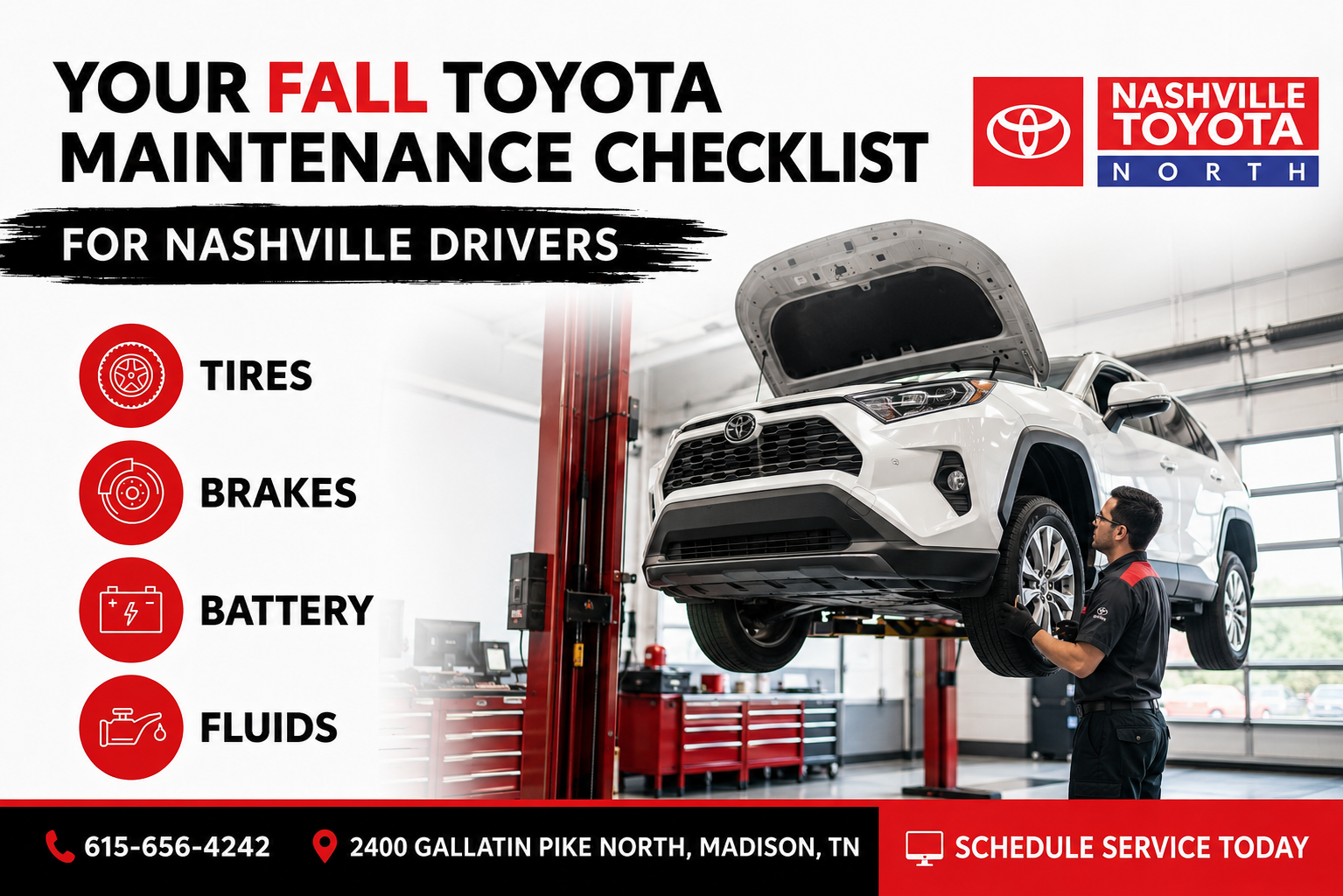
Toyota SUV being serviced by a technician for fall maintenance at a Nashville dealership

Your Toyota Fall Maintenance Checklist for Nashville Drivers

As late summer eases into fall across Middle Tennessee, the way you use your Toyota starts to shift. Morning commutes get a little cooler, football weekends fill up the calendar, and holiday road trips to see family are suddenly closer than they seem. This is the ideal window to get ahead of seasonal wear before the temperature drops. A little attention now helps your vehicle handle everything from a rainy drive on Gallatin Pike to a longer haul out of the greater Nashville area. Use this Toyota fall maintenance checklist to keep your car, truck, or SUV ready for the months ahead. Why Fall Is the Right Time for Toyota Maintenance in Nashville Middle Tennessee summers are hot and humid, and that heat is hard on a vehicle. By the time fall arrives, your battery, fluids, and rubber components have all put in a long, warm season of work. Cooler weather then introduces a new set of demands, including chilly starts, wet leaves, earlier sunsets, and the occasional cold snap that catches drivers off guard. Staying on top of maintenance as the seasons turn means small issues get caught before they grow. It also means fewer surprises when you are loading up for a weekend trip to the Smokies or heading north through Goodlettsville and Springfield for the holidays. Think of fall service as a reset that carries you comfortably into winter. Following Your Toyota Maintenance Schedule Every Toyota comes with a recommended maintenance schedule based on time and mileage, and that schedule exists for good reason. Following it helps protect performance, efficiency, and long-term reliability. Fall is a natural checkpoint to make sure you are current on oil changes, tire rotations, and inspections. If you have fallen a little behind over a busy summer, this is a great moment to catch up and start the cooler months on solid footing. Tires: Your First Line of Traction Your tires are the only part of your Toyota that actually touch the road, so they deserve early attention. Cooler air causes tire pressure to drop, and underinflated tires affect handling, braking, and fuel economy. Check your pressure as temperatures fall and adjust it to the level recommended for your vehicle. Tread depth matters just as much once fall rains arrive. Nashville sees plenty of wet pavement in autumn, and healthy tread helps channel water away so you keep your grip. Look for uneven wear, and consider a rotation if it has been a while, since even wear extends the life of the set. A technician can also check alignment if your Toyota has been pulling to one side. Brakes: Stopping Power for Wet Roads Fall means slick roads from rain and fallen leaves, which puts your braking system in the spotlight. If you have noticed any squealing, grinding, a soft pedal, or longer stopping distances, have your brakes inspected before the wet season is in full swing. Pads, rotors, and brake fluid all play a role in confident stopping. A thorough brake check gives you peace of mind on hilly neighborhood streets in Hendersonville and on busy stretches of interstate alike. Addressing brake wear early is almost always simpler than waiting until a small issue affects other components. Battery: Avoid the Cold-Weather Surprise Summer heat quietly wears down batteries, and the effects often show up when the first cold morning arrives. A battery that struggled through July may not have much left when temperatures dip. Fall is the smart time to test your battery's condition and check the terminals for corrosion. If your Toyota has been slow to start or your battery is a few years old, a proactive test can save you from an inconvenient no-start in a parking lot. Replacing a tired battery on your schedule is far more pleasant than doing it on a cold Rivergate morning when you are already running late. Fluids: The Lifeblood of Your Toyota Your vehicle relies on several fluids working together, and each one deserves a look as the seasons change. Key Fluids to Check This Fall Engine oil: Clean oil at the correct level protects your engine through temperature swings. If you are due for a change, fall is a natural time. Coolant and antifreeze: This fluid regulates engine temperature and protects against freezing when a cold snap hits Middle Tennessee. Brake fluid: Proper levels and condition support consistent braking performance. Transmission and power steering fluid: These keep your Toyota shifting and steering smoothly. Windshield washer fluid: Easy to overlook, yet essential for clearing grime, rain, and road spray. A technician can inspect these fluids, top off what is low, and flag anything that looks worn. Handling fluids together during one visit keeps your maintenance efficient and thorough. Wipers and Visibility: See and Be Seen Fall brings shorter days and more rain, so clear visibility becomes a daily priority. Wiper blades wear out gradually, and many drivers do not notice until a downpour reveals streaking or chattering. If your blades are leaving streaks or skipping across the glass, it is time for a fresh set. While you are focused on visibility, check that all your exterior lights are working, including headlights, taillights, brake lights, and turn signals. With sunset arriving earlier, working lights help you see the road and help other drivers see you on darker evenings around Madison and Mt. Juliet. HVAC: Comfortable Cabin, Clear Windows Your heating and defrost system moves from optional to essential as the air turns crisp. Test your heat now so you are not troubleshooting on the first cold morning. The defroster is especially important for clearing foggy or frosty windows quickly and safely before you pull out of the driveway. It is also a good time to consider your cabin air filter. A fresh filter supports airflow and helps keep the air inside your Toyota clean, which is a nice comfort upgrade heading into the season when windows stay closed. Trust Genuine Toyota Parts and Factory-Trained Technicians Seasonal maintenance is only as good as the parts and expertise behind it. At the Nashville Toyota North service center, your vehicle is cared for by factory-trained technicians who know Toyotas inside and out. They work with genuine Toyota parts that are designed specifically for your model, which supports proper fit and long-term reliability. A comprehensive visit can also include a multi-point inspection, giving you a clear picture of your Toyota's overall condition and any items worth watching. If you like to plan around value, it is always worth reviewing the current service and parts specials before your appointment so you know what savings may apply. Pricing varies by service and vehicle, so checking ahead helps you plan with confidence. If you want a sense of how a visit unfolds from check-in to completion, our guide on what to expect at a Toyota service center walks you through the experience step by step. Ready to Get Your Toyota Fall-Ready? Fall in Middle Tennessee moves quickly, and a little preparation now pays off through the cooler months and every road trip in between. Whether your Toyota needs a quick check or a full seasonal once-over, the service team at Nashville Toyota North is ready to help you drive with confidence. When it works for your schedule, you can schedule service online and get your vehicle set for the season ahead.