

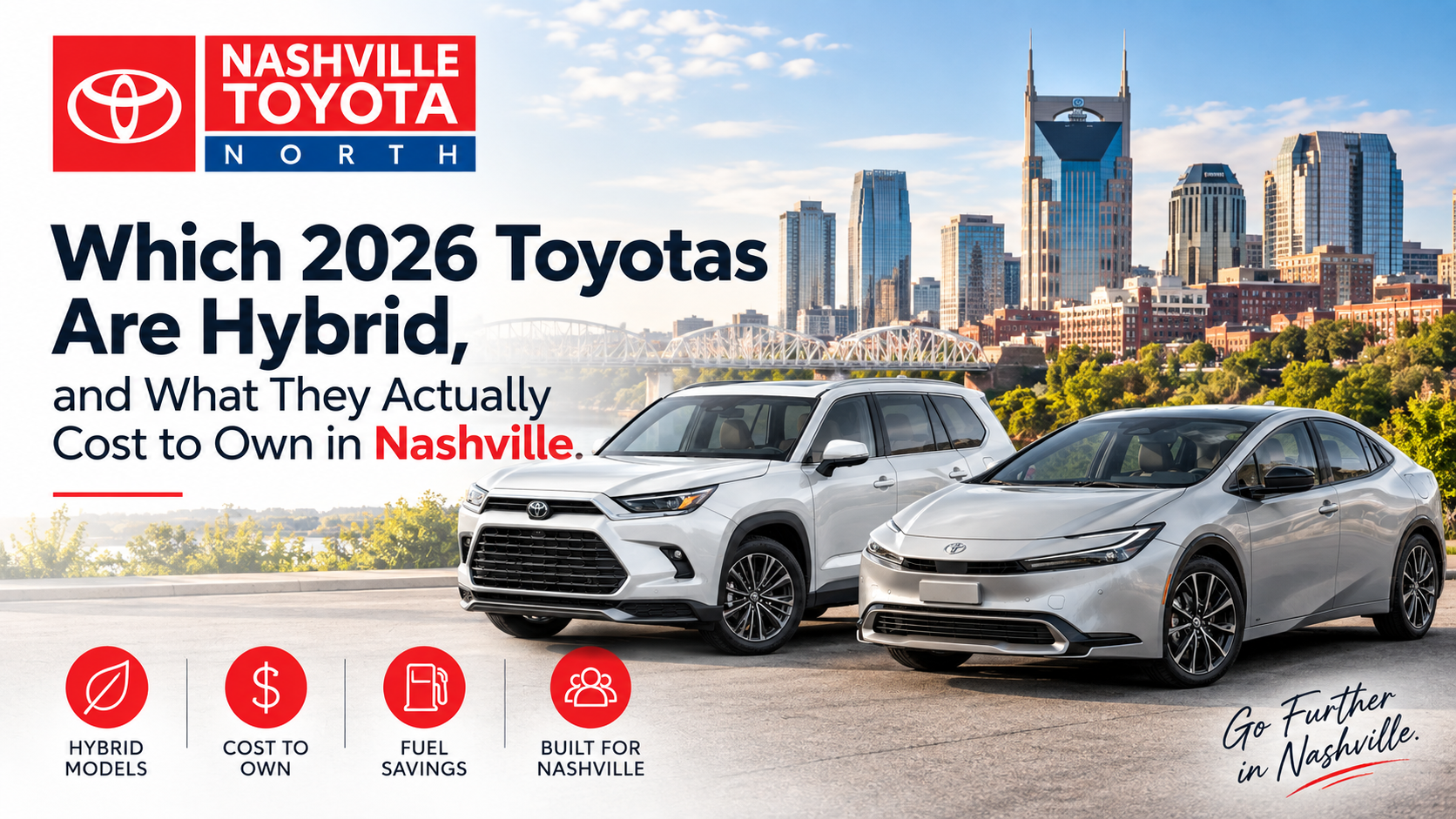
Walk into any Toyota showroom in Middle Tennessee and you will hear the same three questions, usually in the same order. People do not open with horsepower. They open with the things that worry them. Do I have to plug it in? What happens when the battery dies? And does any of this matter if I spend my life on I-65?
Those are good questions. Here are honest answers, followed by a plain list of which 2026 Toyota models actually offer a hybrid powertrain.
1. Do I have to plug it in?
For a conventional hybrid, no. Not ever. Not once.
This is the single biggest misunderstanding about hybrids, and it keeps people from even test driving one. A Toyota hybrid has a gas engine, an electric motor, and a battery, and the car manages all three on its own. Toyota puts it about as simply as it can be put: hybrid electric vehicles “don’t use a plug to charge their battery. Instead, they recycle the kinetic energy captured from the vehicle’s braking motion to recharge on their own.”
That is what regenerative braking means. Every time you lift off the accelerator or slow down for the light at Gallatin Pike, the electric motor works backward as a generator and puts energy back into the battery. Stop and go traffic, which is the worst thing that can happen to a normal gas engine, is actually where a hybrid gets its best work done. You never think about it. You put gas in it. That is the whole routine.
Toyota describes the ownership experience the same way: hybrid electric vehicles “start, refuel and handle like the gas-only Toyotas you already know and love.”
A plug-in hybrid is a different animal. A plug-in hybrid, which Toyota labels clearly in the model name, carries a larger battery that you can charge from an outlet or a charging station. That lets it drive on electricity alone for a stretch before the gas engine takes over. Once that charge is used up, it simply operates as a hybrid and keeps going on gas. You can drive a plug-in hybrid without ever charging it. You just would not be getting the benefit you paid for.
So the rule of thumb is easy. If the name says Plug-in Hybrid, you can plug it in. If it just says Hybrid, there is no plug and no cord and no decision to make.
2. Does the battery die, and what happens if it does?
Batteries are wear items. Everything in a car is a wear item. The real question is how long, and who pays.
Toyota covers the hybrid battery in these vehicles with a 10 year or 150,000 mile limited warranty, whichever comes first. That is on top of the coverage for the rest of the hybrid system. Looking at the official 2026 warranty and maintenance guide for the Grand Highlander Hybrid, the other hybrid-related components, things like the battery control module, the hybrid control module, and the inverter with converter, carry 8 year or 100,000 mile coverage from the vehicle’s in-service date.
Read those numbers again, because they are the answer to the anxiety. A hybrid battery is not a mystery box with a short fuse on it. It is a covered component with a longer warranty term than most of the car around it.
A few practical points for Nashville owners:
- Heat and cold both matter, and neither is extreme here. Middle Tennessee summers are humid but our climate is nowhere near the punishing desert heat that battery packs dislike most. Toyota’s hybrid batteries are actively managed and cooled by the vehicle, not left to fend for themselves.
- Degradation is gradual, not sudden. A hybrid battery does not go from fine to dead overnight. Capacity fades slowly, and the car keeps operating as a hybrid while it does.
- Service is normal service. Hybrid systems are diagnosed and maintained by trained technicians using Toyota procedures. If you want a straight answer about your specific vehicle, our service center can inspect the hybrid system and tell you what it sees.
The honest caveat: no warranty covers everything forever, terms have conditions, and coverage details vary by model and by how the vehicle has been maintained. Read the warranty guide for the specific vehicle you are considering. It is published by Toyota and it is not hard to follow.
3. Is a hybrid still worth it if I mostly drive highway?
This is the sharpest question of the three, and it deserves a real answer instead of a sales pitch.
A hybrid’s biggest advantage shows up in stop and go driving. That is where regenerative braking captures the most energy and where the electric motor does the most work while the gas engine rests. If your commute is Hillsboro Village to downtown, you are in the ideal case.
At a steady 70 miles per hour on I-40, the gas engine is doing most of the propelling, and the efficiency gap between a hybrid and a comparable gas model narrows. That is simply how the technology works, and any dealer who tells you otherwise is not being straight with you.
But “narrows” is not “disappears,” and three things are worth weighing:
Almost nobody drives only highway. Nashville traffic being what it is, even a highway commuter spends real time crawling on the ramp at Briley Parkway or sitting through the merge at the 440 interchange. Those are exactly the conditions where the hybrid pays you back. Your actual fuel cost depends on your actual driving mix, so be honest with yourself about what your week really looks like.
Hybrids are not slower. This is a leftover reputation from twenty years ago. The 2026 4Runner offers an i-FORCE MAX Hybrid rated at up to 326 horsepower and 465 lb.-ft. of torque, which is more of both than its non-hybrid i-FORCE engine. The Grand Highlander offers a Hybrid MAX powertrain positioned by Toyota for power and performance, not just efficiency. The electric motor’s instant torque is genuinely useful when you are merging.
Traction can come with the package. On several models, all-wheel drive is part of the hybrid setup. Every 2026 Corolla Cross Hybrid, for example, comes with Electronic On-Demand All-Wheel Drive as standard equipment. That is a nice thing to have on the two or three genuinely ugly winter mornings Nashville gets each year.
Which 2026 Toyota models offer a hybrid powertrain
Based on Toyota’s own 2026 model information, here is where hybrid and plug-in hybrid powertrains show up in the lineup.
Hybrid (no plug required):
- Camry
- Corolla Hybrid
- Corolla Cross Hybrid
- Prius
- Sienna
- Highlander Hybrid
- Grand Highlander Hybrid, including the Hybrid MAX powertrain
- RAV4 Hybrid
- 4Runner, with the available i-FORCE MAX Hybrid
- Crown and Crown Signia
- Sequoia
- Tacoma and Tundra, with available hybrid powertrains
Plug-in Hybrid (you can charge it):
- Prius Plug-in Hybrid
- RAV4 Plug-in Hybrid
A note on how Toyota names things. Several nameplates exist in both gas and hybrid form, and Toyota distinguishes them right in the model name. Highlander and Highlander Hybrid are listed separately. So are Grand Highlander and Grand Highlander Hybrid, Corolla Cross and Corolla Cross Hybrid, and RAV4, RAV4 Hybrid, and RAV4 Plug-in Hybrid. If the word Hybrid is in the name, the hybrid system is in the car.
One thing we are not going to tell you
You will see plenty of articles quoting a specific federal or state tax credit amount for hybrids and plug-in hybrids. We are not going to do that, because those rules change, eligibility depends on the vehicle and on your personal tax situation, and a number that was accurate last year can be wrong today. If incentives matter to your decision, confirm current federal and Tennessee eligibility with the official sources and with your tax advisor before you sign anything.
The short version
If the name does not say Plug-in, you never plug it in. The hybrid battery carries a 10 year or 150,000 mile limited warranty. And highway driving narrows the hybrid advantage without erasing it, especially in a city where nobody’s commute is really all highway.
Come drive one. That answers more questions in fifteen minutes than any article will.