Blog / Madison New Cars

How to Lease a Car for the First Time: A Complete Step-by-Step Guide

Three people in business attire are looking at a red folder with documents in a dealership.
Leasing a car for the first time can feel intimidating, especially when you encounter unfamiliar terms like money factor, residual value, and cap cost reduction. The good news is that once you understand how a car lease works, the process is straightforward and often results in lower monthly payments than financing a purchase.This guide walks you through everything you need to know before you walk into a dealership, so you can negotiate with confidence and choose a lease structure that fits your budget and lifestyle.

What Is a Car Lease and How Does It Work?

A car lease is a long-term rental agreement between you and a dealership or finance company. Rather than purchasing the vehicle outright, you pay for the right to use it for a set period, typically 24 to 48 months, with a fixed number of miles per year.At the end of the lease term, you return the vehicle, purchase it at a predetermined price, or lease a new model. You never own the car during the lease unless you choose to buy it at the end.The monthly lease payment is calculated based on how much the car is expected to depreciate during your lease term, plus interest and fees. Because you are only paying for depreciation rather than the full vehicle price, lease payments are typically lower than loan payments for the same vehicle.

Key Lease Terms Every First-Time Lessee Should Know

Before signing anything, make sure you understand these essential terms:
  • Capitalized Cost (Cap Cost): This is the negotiated selling price of the vehicle. Like a purchase price, this is negotiable. A lower cap cost means lower monthly payments.
  • Residual Value: The estimated value of the vehicle at the end of the lease term, expressed as a percentage of the MSRP. A higher residual value generally means lower monthly payments.
  • Money Factor: This is the interest rate on your lease, expressed as a small decimal (e.g., 0.00125). Multiply it by 2,400 to convert it to an approximate APR. This figure is not always disclosed upfront, so ask for it.
  • Mileage Allowance: Most leases allow 10,000 to 15,000 miles per year. Driving over your allotted miles results in per-mile overage charges at lease end, typically between 15 and 25 cents per mile.
  • Gap Coverage: If your leased vehicle is totaled or stolen, gap coverage pays the difference between what your insurance pays and what you owe on the lease. Many leases include this automatically.
  • Disposition Fee: A fee charged at the end of the lease if you choose not to purchase the vehicle or lease another from the same brand. It typically ranges from $300 to $400.

Is Leasing Right for You? Questions to Ask Yourself

Leasing makes the most sense in specific situations. Consider the following questions before deciding:
  • Do you prefer driving a new vehicle every two to three years? Leasing makes it easy to upgrade at the end of each term.
  • Do you drive fewer than 12,000 to 15,000 miles per year? Staying within the mileage limit is one of the most important factors in making a lease financially beneficial.
  • Do you take good care of your vehicles? Lease agreements require you to return the car in good condition. Excess wear and tear can result in additional charges at turn-in.
  • Is your monthly budget the primary concern? Lease payments are almost always lower than loan payments for the same vehicle and loan term.
  • Do you itemize deductions if you use the car for business? Leased vehicles used for business purposes may offer additional tax advantages worth discussing with your accountant.
If most of your answers point toward yes, leasing is likely a strong fit. If you drive high miles, prefer to own outright, or want the freedom to modify your vehicle, purchasing may serve you better.

Step-by-Step: How to Lease a Car for the First Time

Step 1: Choose the Right Vehicle

Not all vehicles lease equally. Models with high residual values and manufacturer lease incentives will offer the best monthly payments. Toyota consistently offers competitive lease programs on popular models like the Camry, Corolla, RAV4, and Tacoma. Research current lease specials before deciding on a model.

Step 2: Check Your Credit Score

Your credit score directly affects your money factor, which is the interest rate built into your lease payment. A score above 700 typically qualifies you for tier-one rates, meaning the lowest available money factor. Before visiting a dealership, pull your credit report, address any errors, and know where you stand.

Step 3: Research Current Lease Offers

Manufacturers publish monthly lease programs through their captive finance arms, like Toyota Financial Services. These programs set the residual value and money factor for each model. Checking these numbers before you negotiate helps you evaluate whether a dealer's offer is competitive or inflated.

Step 4: Negotiate the Cap Cost

Many first-time lessees do not realize that the vehicle price is negotiable even on a lease. The lower you can negotiate the capitalized cost, the lower your monthly payment will be. Treat the cap cost negotiation the same way you would negotiate a purchase price.

Step 5: Select Your Term and Mileage

Choose a lease term that matches your lifestyle. A 36-month lease is the most common and often aligns with manufacturer warranty coverage, meaning major mechanical issues are typically covered for the full lease period. Select a mileage allowance that reflects your actual driving habits. Under-buying miles is one of the most common and costly lease mistakes.

Step 6: Review the Lease Agreement Carefully

Before signing, confirm the cap cost, residual value, money factor, mileage allowance, and all fees in writing. Ask the finance manager to walk you through each line item. Do not hesitate to take time to review the contract before committing.

Common Mistakes First-Time Lessees Make

  • Focusing only on the monthly payment: A low monthly payment can be structured in ways that cost you more overall. Always evaluate the full cost of the lease, including fees and any down payment required.
  • Not accounting for mileage accurately: Overages at lease end can add up quickly. Be realistic about your driving habits and choose a mileage allowance that gives you a comfortable buffer.
  • Skipping gap coverage: While many leases include it, confirm that gap coverage is part of your agreement before signing.
  • Ignoring wear and tear standards: Review what the leasing company considers normal versus excess wear so you are not surprised by charges at turn-in.
  • Not comparing multiple vehicles: Different models lease very differently depending on residual values and money factors. Getting quotes on two or three vehicles helps you find the best overall value.

What to Expect at the End of Your Lease

As your lease end date approaches, you have three options. You can return the vehicle, inspect it for any excess wear and tear charges, and walk away. You can purchase the vehicle at the residual value listed in your original lease agreement. Or you can lease a new vehicle, which often makes the transition straightforward when working with the same dealership.Most dealerships will schedule a pre-inspection several weeks before your turn-in date so you know what, if anything, needs to be addressed. This gives you the opportunity to handle minor repairs on your own rather than paying the leasing company's rates.

Start Your First Lease at Nashville Toyota North

Nashville Toyota North offers current lease programs on the full Toyota lineup, with dedicated finance specialists who can walk you through every step of the process. Whether you are interested in a Corolla, a RAV4, or a Highlander, the team can help you structure a lease that fits your budget and your driving habits.  
Posted in:

Related Posts

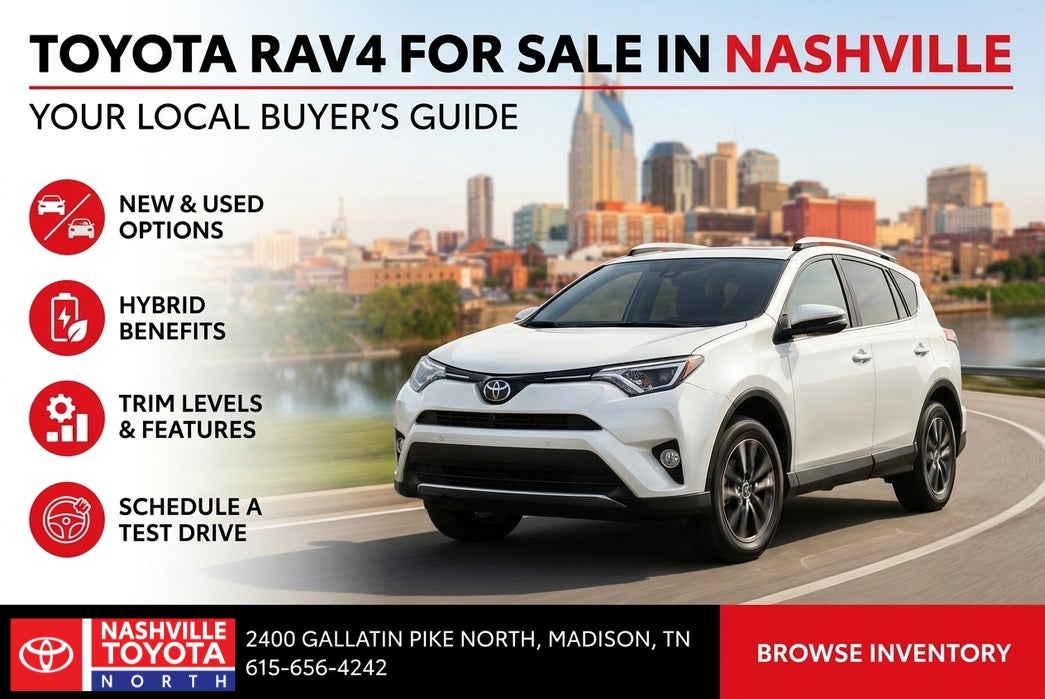
driving on a road above a Nashville skyline, plus icons for new/used options, hybrid benefits, trim features, and scheduling a test drive.

Toyota RAV4 for Sale in Nashville: A Local Buyer's Guide

If you have been searching for a Toyota RAV4 for sale in Nashville, you are shopping for one of the most popular vehicles on the road across Middle Tennessee. The RAV4 shows up in driveways from Madison to Mt. Juliet, and for good reason. It blends everyday practicality with the reliability the Toyota name is known for. This guide walks through why the RAV4 is such a favorite, how to think about new versus used versus certified pre-owned, whether a hybrid or gas model fits your driving, and how to shop for one smartly close to home. Why the Toyota RAV4 Is So Popular in Nashville The RAV4 sits in the compact SUV space, which happens to be exactly what a lot of Nashville area drivers are looking for. It is roomy enough for a growing family, easy to park in tighter spots downtown, and comfortable on longer runs out to Hendersonville or Springfield for the weekend. Its available all-wheel drive gives added confidence when the occasional winter weather rolls through the region. Beyond the practical fit, the RAV4 carries Toyota's reputation for holding up well over time. Shoppers who value dependability tend to keep coming back to it, and that steady demand is part of why you see so many on the road here. If you want a broader sense of how the RAV4 compares to other dependable options in the lineup, our guide to the most reliable Toyota models (https://www.nashvilletoyotanorth.com/blogs/4569/the-most-reliable-toyota-models-which-one-is-right-for-you) is a helpful place to start. Toyota RAV4 for Sale in Nashville: New, Used, or Certified Pre-Owned One of the first decisions you will make is which category of RAV4 makes the most sense for your situation. Each path has its own strengths, and the right answer depends on your budget, your timeline, and how you like to drive. Buying New A new RAV4 gives you the latest features, the newest technology, and the full factory warranty coverage. If you plan to keep a vehicle for many years and want to start with a clean slate, buying new is a natural fit. You can browse the current new Toyota inventory (https://www.nashvilletoyotanorth.com/searchnew.aspx) to see which RAV4 configurations are available right now. Buying Used A used RAV4 can be an appealing route for shoppers who want to stretch their budget or step into a slightly older model. Because the RAV4 tends to hold up well, a well cared for used example can still deliver plenty of dependable miles. Availability of specific model years and mileage ranges changes often, so it helps to check what is on the lot when you are ready. Certified Pre-Owned Certified pre-owned sits between new and traditional used. A certified RAV4 has been inspected and reconditioned to meet Toyota's standards, and it typically comes with added warranty coverage that a standard used car does not include. For drivers who want extra peace of mind without the cost of a brand new vehicle, this can be a comfortable middle ground. Hybrid or Gas: Choosing the Right RAV4 The RAV4 is offered in both traditional gas and hybrid forms, and picking between them comes down to how and where you drive. The hybrid appeals to commuters who spend a lot of time in stop and go traffic around the interstates and surface streets of greater Nashville, since hybrids tend to shine in that kind of city driving. If your daily routine involves plenty of local errands and a regular commute, the efficiency can be a real benefit over time. The gas RAV4 remains a straightforward, familiar choice that many drivers prefer for its simplicity. If your driving leans toward longer highway stretches or you simply like the traditional setup, the gas model is a solid pick. The best way to decide is to think honestly about your typical week behind the wheel and match the powertrain to it. Understanding RAV4 Trims Without Getting Lost The RAV4 comes in several trim levels, and each one bundles a different mix of features, styling, and capability. Rather than getting lost in the details, it helps to think in broad terms about what matters most to you. Some drivers prioritize comfort and technology, while others want a more rugged, adventure ready setup for weekend trips. Trims can differ in things like interior materials, available driver assistance features, wheel styling, and drivetrain options. Since the specifics vary by model year and availability, the smartest approach is to identify your must haves first, then let the sales team point you toward the trims that check those boxes. How to Shop for a RAV4 Locally Shopping close to home has real advantages. Working with a Nashville area dealership means you can see the vehicle in person, ask questions face to face, and get a feel for the service relationship you will have after the sale. Before you visit, it helps to set a rough budget and think through your priorities, such as seating, cargo space, fuel type, and the features you use most. From there, checking online inventory ahead of time lets you arrive with a shortlist rather than starting from scratch. When you are comparing options across Madison, Goodlettsville, Rivergate, and the surrounding suburbs, a local dealership can also walk you through financing, leasing, and trade-in questions in one place. Test-Driving Tips A test drive tells you things a spec sheet never will. When you take a RAV4 out, try to mimic your real routine. Drive on both surface streets and a stretch of highway if you can. Pay attention to visibility, seat comfort, how easily the controls fall to hand, and how the cargo area fits your everyday gear. If you are choosing between hybrid and gas, drive both back to back so the difference is fresh in your mind. Other Strong Toyota Sellers Worth Considering The RAV4 may be the headliner, but it is far from the only Toyota worth a look for Nashville shoppers. A few other consistent favorites are worth putting on your radar. The Corolla is a longtime pick for drivers who want an efficient, easy to own sedan that fits city life. The Camry offers a roomier sedan experience with a comfortable ride for commuters covering more miles. And the Highlander steps up in size for families who need three rows of seating without moving into full size territory. If a compact SUV like the RAV4 turns out to be slightly too small or too large for your needs, one of these models may line up better. Exploring the full lineup helps you feel confident that the vehicle you choose truly fits your life. Ready to Find Your Toyota RAV4 in Nashville? Finding the right RAV4 is easier when you know what you are looking for and have a local team ready to help. Whether you are leaning toward new, used, or certified pre-owned, and whether a hybrid or gas model suits you best, the next step is simple. Reach out to Nashville Toyota North to ask questions, check current availability, or request a quote (https://www.nashvilletoyotanorth.com/contactus.aspx) at your own pace. When you are ready, come see the RAV4 in person and take one for a drive around the neighborhoods you know best.


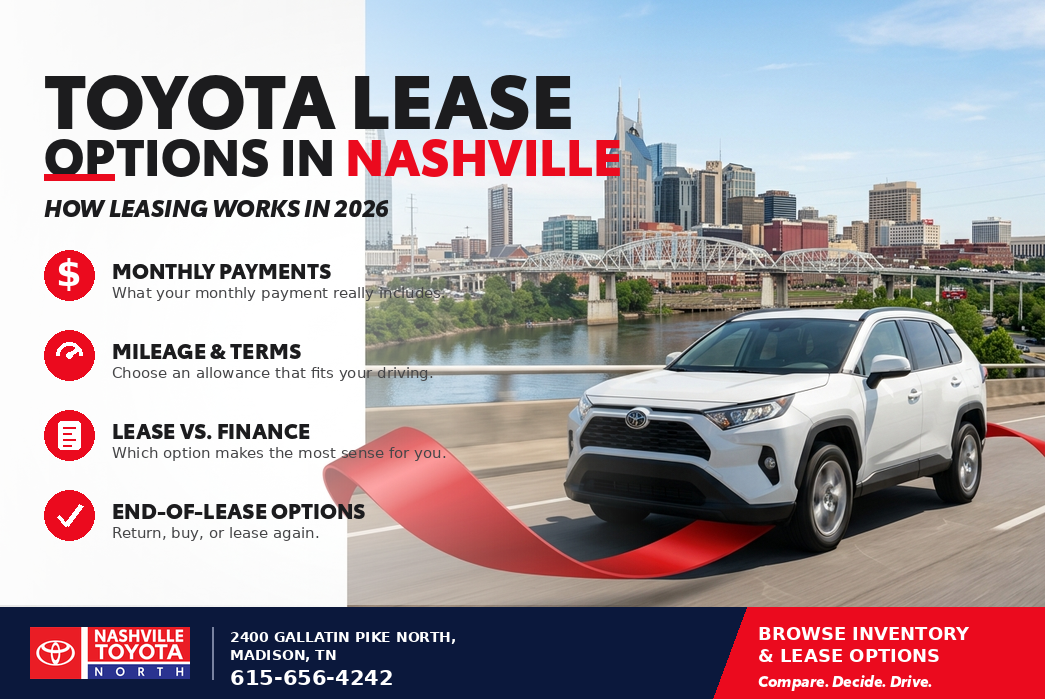
New Toyota parked at a Nashville dealership representing Toyota lease options

How Leasing a Toyota Works in Nashville: Terms, Mileage & What to Expect

If you have been weighing a Toyota lease in Nashville but are not sure how the process actually works, you are not alone. Leasing looks different from a traditional purchase, and understanding the terms up front makes it easier to decide whether it fits your driving habits and budget. This guide walks through the mechanics of how leasing a Toyota works, what a lease agreement typically covers, and what to expect from the day you sign to the day the lease ends. What Does It Mean to Lease a Toyota? When you lease a Toyota, you are paying to drive the vehicle for a set period of time rather than buying it outright. Think of it as a long-term agreement to use the car under agreed-upon conditions. At the end of the term, you return the vehicle, and from there you have several paths to choose from. Because you are not paying toward full ownership, a lease is structured around the vehicle’s expected value over the term rather than its entire cost. The agreement spells out how long you can keep the car, how many miles you can drive, and the condition it should be in when you bring it back. The Core Parts of a Lease Agreement Most Toyota lease agreements share a few common elements: Term length: the number of months the lease runs, commonly a set span such as two or three years. Mileage allowance: the total miles you are permitted to drive over the life of the lease. Condition expectations: guidelines for normal versus excess wear. End-of-lease options: what you can do when the term wraps up. Reviewing these details before you sign helps you match a lease to how you actually drive. You can explore current leasing options with the team at Nashville Toyota North to see how these pieces come together for the model you have in mind. Lease vs. Finance: How They Differ One of the most common questions Nashville shoppers ask is whether to lease or finance a Toyota. Both are legitimate ways to drive a new vehicle, and the right choice depends on your priorities. When Financing May Make Sense Financing is a path toward ownership. You take out a loan, make payments over the term, and once the loan is paid off, the vehicle is yours to keep with no mileage limits and no condition guidelines to worry about. If you tend to keep cars for many years, drive long distances, or like the idea of building toward an asset you own, financing may be the better fit. If you are comparing loan structures, our overview of dealer financing versus bank financing in Nashville breaks down how each works. When Leasing May Make Sense Leasing tends to appeal to drivers who like having a newer vehicle more often and who have fairly predictable driving patterns. Because you return the car at the end of the term, you can move into a different Toyota when your lease ends rather than dealing with a private sale or trade. Drivers who value the latest features and technology, and who stay within a consistent mileage range, often find leasing aligns well with their lifestyle. Understanding Mileage Limits Mileage is one of the defining features of any car lease in Nashville. Every lease includes an allowance, and staying within it is an important part of a smooth experience. Before you sign, it helps to estimate how much you drive in a typical year. Consider your commute across the metro area, weekend trips, and any regular travel. If you routinely rack up long distances, you can discuss a higher mileage allowance up front. If you drive less, a standard allowance may be plenty. Going over the agreed mileage generally results in a per-mile charge at the end of the term, so choosing an allowance that reflects your real habits is one of the smartest things you can do when you lease a Toyota. Wear and Tear: What to Expect Leases distinguish between normal wear and excess wear. Normal wear covers the ordinary signs of everyday driving, the kind of minor marks any vehicle picks up over time. Excess wear refers to damage beyond that baseline, such as significant dents, deep scratches, interior damage, or worn tires below acceptable limits. To keep things straightforward at lease-end, treat the vehicle with routine care. Keeping up with scheduled maintenance, addressing issues promptly, and keeping the interior clean all help ensure the car comes back in good shape. If you are unsure whether something counts as excess wear, the service and leasing teams can walk you through the guidelines well before your term ends. End-of-Lease Options As your lease term winds down, you generally have a few directions to consider: Return the vehicle and lease again: hand back your current Toyota and move into a new lease, often a popular choice for drivers who like staying in a newer model. Purchase the vehicle: many leases include the option to buy the car you have been driving. If you have grown attached to it, this can be a convenient route. Return and finance a different vehicle: bring back the leased Toyota and transition into a purchase, whether new or certified pre-owned. Knowing these options ahead of time makes the end of your lease feel less like a deadline and more like a decision point. Why Lease a Toyota in Nashville? Nashville’s mix of daily commuting, growing neighborhoods, and weekend getaways makes reliability and versatility valuable in a vehicle. Toyota’s lineup spans efficient sedans, family-friendly SUVs, capable trucks, and hybrids, so there is likely a model that fits how you move around the area. Leasing can be an approachable way to get behind the wheel of a new Toyota and enjoy up-to-date features while keeping your plans flexible. You can browse the current new inventory to see what is available, and review financing information if you want to compare paths. Ready to Learn More? Understanding how a lease works is the first step toward choosing the option that suits you best. If you have questions about terms, mileage, or which Toyota might be the right fit, the team at Nashville Toyota North is happy to help. When you are ready, you can schedule a test drive or reach out to explore your leasing options at your own pace.

Toyota shopper reviewing auto loan and financing options in Nashville

Toyota Financing in Nashville: Dealer vs. Bank, and How to Prepare

Buying a Toyota is exciting, but figuring out how to pay for it can feel like the harder part of the decision. Should you finance through the dealership or line up a loan at your own bank first? What do lenders actually look at, and how can you walk in ready? If you are a Nashville-area shopper getting close to a purchase, understanding your car financing options ahead of time can make the whole process calmer and clearer. This guide breaks down how Toyota financing in Nashville generally works, how dealer and bank financing compare, and the practical steps you can take before you ever sit down to sign. How Toyota Financing in Nashville Works At its core, financing a vehicle means borrowing money to buy the car now and repaying it over time in monthly installments. An auto loan is secured by the vehicle itself, which is one reason car loans are so widely available. When you finance at a dealership, the dealer works with lending partners on your behalf. In Toyota’s case, that often includes Toyota Financial Services (TFS), the captive lender associated with the brand, as well as banks and credit unions the dealership partners with. You complete a credit application, and the dealership submits it to potential lenders to find a loan offer that fits your situation. The role of Toyota Financial Services Because Toyota Financial Services is tied directly to the manufacturer, it frequently supports promotional programs on eligible new Toyota models. Availability and terms vary by model, credit profile, and timing, so the right move is to ask the finance team what current programs you may qualify for rather than assuming. You can start that conversation through the Nashville Toyota North finance page, which lets you begin the process online before visiting. Dealer Financing vs. Bank Financing One of the most common questions shoppers ask is whether to finance through the dealer or arrange a loan through their own bank. Both are legitimate paths, and each has strengths. Financing through the dealership Dealer financing is convenient because the application and the purchase happen in one place. Since the dealership submits your application to multiple lending partners, it can compare several potential offers at once, which may surface options you would not have found on your own. Manufacturer-supported programs through Toyota Financial Services are also generally accessed this way, so dealer financing is often where brand-specific opportunities live. Financing through a bank or credit union Getting pre-approved through your own bank or a local Nashville credit union before you shop gives you a reference point. You arrive knowing roughly what a lender is willing to offer, which can make comparing the dealership’s offer more straightforward. Some buyers value the existing relationship they have with their credit union, while others simply like having a number in hand. Which is right for you? There is no single correct answer. Many buyers do both: they get pre-approved at a bank or credit union, then let the dealership try to match or improve on it. Comparing offers side by side is the goal, and having more than one option only strengthens your position. For a deeper look at this comparison, our related post, Toyota Auto Loans Explained: Dealer Financing vs. Bank Financing in Nashville, walks through the trade-offs in more detail. What to Prepare Before You Apply A little preparation goes a long way toward a smoother auto loan experience. Here is what tends to matter most. Understand your credit Lenders review your credit history to help determine the terms they can offer. Before applying, it is worth checking your credit report so you know where you stand and can correct any errors. You do not need a perfect profile to explore financing, but knowing your situation helps you set realistic expectations and ask better questions. Think through your down payment A down payment is the amount you pay upfront toward the vehicle. Putting money down reduces the amount you need to borrow, which in turn affects your monthly payment and the total you repay over the life of the loan. Even a modest down payment can be meaningful. Consider what you can comfortably contribute without stretching your budget. Gather your documents Having paperwork ready speeds things up. Lenders commonly ask for proof of income, proof of residence, a valid driver’s license, and insurance information. If you are trading in a vehicle, bring its title or loan details as well. Consider special circumstances Buyers who are early in their credit journey, rebuilding, or facing other challenges still have paths forward. Nashville Toyota North offers a special financing option designed to help more shoppers explore what may be possible. Submitting an inquiry does not obligate you to anything; it simply opens a conversation. Understanding Your Loan Terms Once you receive an offer, a few key terms shape what your car financing will look like day to day. Loan term is the length of time you have to repay. A longer term generally lowers the monthly payment but increases the total interest paid over time; a shorter term does the opposite. Interest rate and APR reflect the cost of borrowing. Your rate depends on factors such as your credit profile, the loan term, and current lending conditions. Monthly payment is what you pay each month, shaped by the amount financed, the term, the rate, and your down payment. The healthiest way to think about it is as a balance: term, down payment, and rate all work together, and the right combination is the one that fits your monthly budget and your longer-term goals. Financing at the Dealership in Nashville When you are ready, the finance team at Nashville Toyota North can walk you through your options, answer questions, and help you understand each offer before you decide. There is no pressure to commit simply because you started an application, and asking questions is always encouraged. Ready to Take the Next Step? Preparing ahead of time turns Toyota financing in Nashville from a stressful unknown into a straightforward part of buying your next vehicle. When you feel ready, explore the new inventory to find the Toyota that fits you, or reach out to the finance team to start the conversation. We are here to help you move forward with confidence.