

Blog / Buying Tips: trade-ins, shopping guides

Toyota 4Runner Buyer’s Guide for Middle Tennessee: How to Pick Your Grade

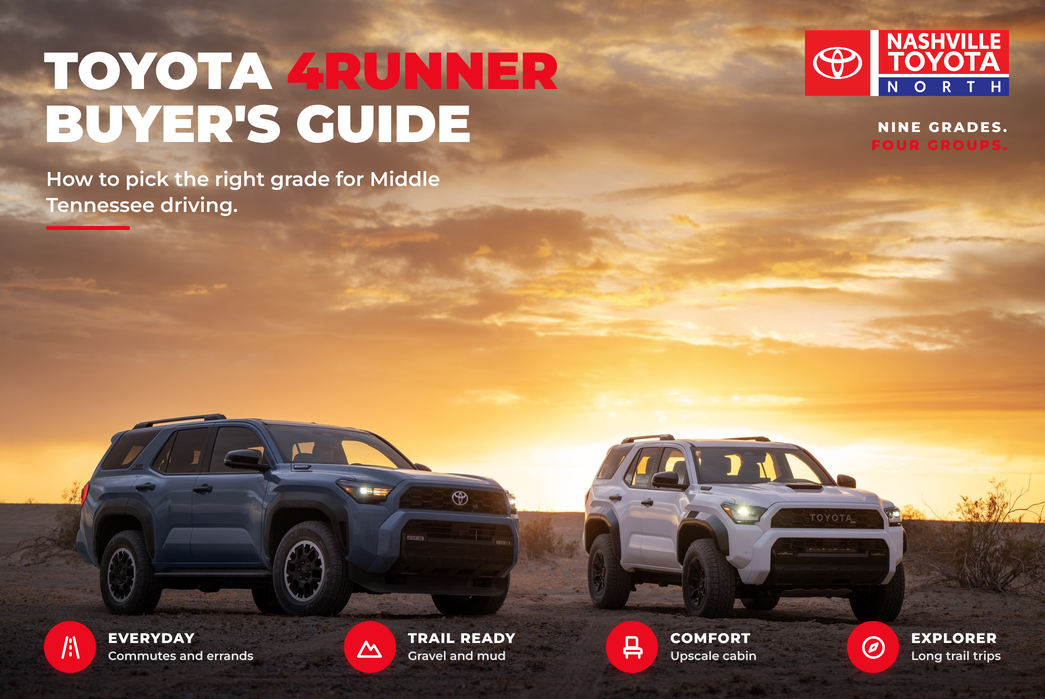
2026 Toyota 4Runner buyer’s guide graphic from Nashville Toyota North

Toyota 4Runner Buyer’s Guide for Middle Tennessee: How to Pick Your Grade

The Toyota 4Runner has a reputation that sells itself. People in Nashville buy them for the same reasons people everywhere do: they are tough, they are capable, and they feel like they will still be running when your kids are old enough to borrow them.

The harder question is which 4Runner. The 2026 lineup has nine grades and two engines, and they are built for noticeably different drivers. This guide sorts them into four simple groups so you can walk in knowing which ones to try.

First, the Two Engines

Every 2026 4Runner uses one of two powertrains.

  • i-FORCE 2.4 liter turbo: up to 278 horsepower and 317 lb.-ft. of torque. It is standard on the SR5, TRD Sport and TRD Sport Premium grades.

  • i-FORCE MAX hybrid: 326 horsepower and 465 lb.-ft. of torque. It is standard on the Platinum, TRD Pro and Trailhunter grades.

The hybrid here is not about squeezing out the best fuel economy. It is about extra pulling power, the kind you feel climbing a steep grade on I-24 toward Monteagle or pulling up a gravel boat ramp. Toyota’s EPA estimated highway rating is 26 MPG for the i-FORCE engine and 24 MPG for the i-FORCE MAX.

Both engines share a maximum towing capacity of 6,000 pounds when properly equipped, which covers most bass boats, pontoons, small campers and utility trailers.

Group One: The Everyday 4Runner (SR5, TRD Sport, TRD Sport Premium)

These grades are for drivers who want the 4Runner’s toughness and personality but spend most of their time on pavement. Think commuting from Hendersonville or Goodlettsville, hauling sports gear on weekends, and the occasional gravel road to a trailhead.

The TRD Sport grades add a sportier look and on road feel. If your 4Runner will mostly live on Briley Parkway and Ellington, start here.

Group Two: The Trail Ready 4Runner (TRD Off-Road, TRD Off-Road Premium)

This is the classic 4Runner for people who actually leave the pavement. If your weekends include forest roads on the Cumberland Plateau, muddy campsites at Land Between the Lakes or a rough drive back to a fishing spot, the TRD Off-Road grades are where the 4Runner’s off road equipment really shows up.

For 2026, Toyota made a Stabilizer Disconnect feature optional on the i-FORCE MAX TRD Off-Road Premium. In plain terms, it lets the front suspension move more freely over rough ground so the tires stay planted.

Group Three: The Comfortable 4Runner (Limited, Platinum)

Not everyone who loves the 4Runner wants to rock crawl. The Limited and Platinum grades lean into comfort and features for drivers who want a rugged SUV that feels upscale inside. The Platinum comes standard with the i-FORCE MAX hybrid, so you get the strongest engine along with the nicer cabin.

Group Four: The Serious Explorer (TRD Pro, Trailhunter)

These are the top of the off road lineup, both standard with the i-FORCE MAX hybrid. The TRD Pro is built for performance off road. The Trailhunter is built for overlanding, which means long trips with camping gear where the vehicle is your base camp. If you are planning that kind of adventure, these are the two to drive.

Tech and Safety on Every Grade

Toyota Safety Sense 3.0 is standard on every 2026 4Runner. That bundle includes driver assist features like a pre collision system with pedestrian detection and full speed range dynamic radar cruise control, which is welcome on a stop and go I-65 commute.

An 8 inch multimedia screen is standard, and a 14 inch touchscreen is available. The power rear window, a 4Runner signature, is standard, and a hands free power liftgate is available.

Quick Guide

If you mostly…

Start with

Engine

Commute and run errands

SR5, TRD Sport, TRD Sport Premium

i-FORCE

Head off road on weekends

TRD Off-Road, TRD Off-Road Premium

i-FORCE or i-FORCE MAX

Want comfort and features

Limited, Platinum

Platinum: i-FORCE MAX

Plan serious trail trips

TRD Pro, Trailhunter

i-FORCE MAX

Engine availability varies by grade. Max towing of 6,000 lbs. applies to properly equipped models.

4Runner or RAV4?

This comes up a lot. Both are Toyota SUVs that seat five and both are popular in Middle Tennessee, but they are built for different priorities.

The RAV4 is a crossover. It rides like a car, every 2026 RAV4 is a hybrid, and it is the more efficient daily driver. The 4Runner is a body on frame SUV, built more like a truck, which is what gives it its off road toughness and its 6,000 pound towing rating.

If your weekends are mostly paved and fuel economy is the number you watch, the RAV4 probably fits better. If you tow, head off road, or simply love the way a 4Runner feels and looks, the 4Runner is worth the trade.

What to Check on Your Test Drive

A short checklist makes a test drive far more useful. Bring it along.

  1. Load your real stuff. Bring the cooler, the car seat or the tackle box and see how it fits with the rear seats up.

  2. Drop the rear window. Try the power rear window. Owners who haul long gear or have a dog in the back tend to love it.

  3. Get on the interstate. Merge onto I-65 or Briley Parkway and pay attention to how each engine feels when you need power.

  4. Try both screens. If you are deciding between grades, compare the standard 8 inch screen with the available 14 inch touchscreen.

  5. Ask about towing. If you plan to tow, tell us what and how much so we can point you to a properly equipped 4Runner.

Taking Care of It Once It Is Yours

A 4Runner earns its reputation partly because owners keep up with the basics. Every new Toyota comes with ToyotaCare, a no cost maintenance plan, and our service center on Gallatin Pike is set up to handle all of it, from routine oil changes to post trail inspections.

Come See Them in Person

The fastest way to narrow down nine grades is to sit in a few. Our team at Nashville Toyota North can line up an everyday grade next to a TRD Off-Road so you can feel the difference. Start by exploring the 2026 Toyota 4Runner, browse our new inventory online, then come by for a test drive. And if you are deciding between a 4Runner and a family SUV, our RAV4 vs Highlander guide is a good next read.


Posted in:

Recommended Posts

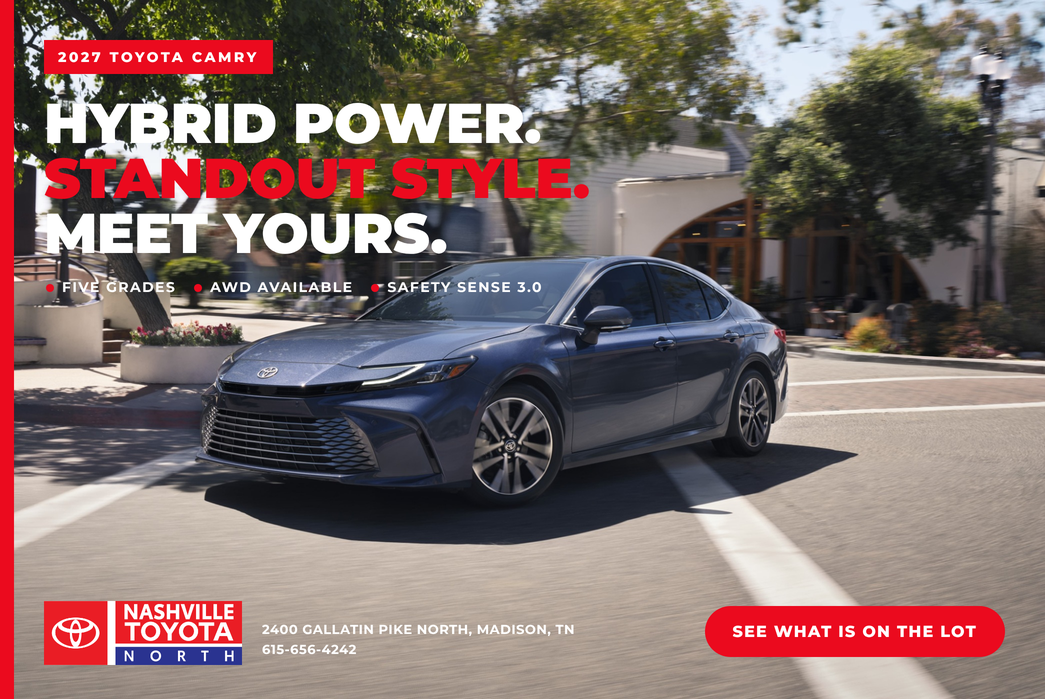
2027 Toyota Camry featured in a Nashville Toyota North blog post on grades, hybrid power and all wheel drive

2027 Toyota Camry in Nashville: Grades, Hybrid Power and What Is on the Lot

2027 Toyota Camry in Nashville: Grades, Hybrid Power and What Is on the Lot The Camry has been the sensible choice in Nashville driveways for decades, and the 2027 model keeps that going: hybrid power, five grades, and all wheel drive available on any of them. You pick a grade, you pick front or all wheel drive, and you go. The 2027 Camry is expected to arrive at Toyota dealerships this fall, so here is what to know before it reaches our lot on Gallatin Pike. What Changed for 2027 Toyota says the grades, features and options carry over for the 2027 model year. If you have been looking at a current Camry, the 2027 is the same car heading into another year, which makes it a known quantity. Hybrid Power and Real World Fuel Economy The 2027 Camry uses Toyota’s fifth generation hybrid system paired with a 2.5 liter four cylinder engine. Output is 225 net combined horsepower with front wheel drive and 232 net combined horsepower with all wheel drive. Power goes through an electronically controlled continuously variable transmission that Toyota says is tuned to give a natural acceleration feel in step with engine speed. Fuel economy is the headline number. Toyota’s manufacturer estimated rating for the LE with front wheel drive is 51 MPG combined. For anyone making the daily run from Hendersonville or Goodlettsville into downtown on I-65, or sitting in the evening crawl on Gallatin Pike, that number does quiet work every week. Every Camry also comes with selectable Normal, Eco and Sport driving modes, so you can lean into efficiency on the commute and firm things up on a weekend drive down Natchez Trace. All Wheel Drive on Any Grade Electronic On Demand All Wheel Drive is available on all five grades. It uses an electric motor on the rear axle, delivers the 232 horsepower figure, and sends torque to the rear wheels when the system senses a slippery road or a loss of grip. Middle Tennessee does not get much snow, but it does get the occasional ice morning and plenty of heavy rain on the interstates, and all wheel drive in a sedan this efficient is a nice thing to have. The Five Grades LE. The starting point. Woven fabric seats with an embossed wave pattern, 16 inch alloy wheels, a black horizontal bar grille, and a 7 inch digital gauge cluster. This is the grade with the 51 MPG combined estimate in front wheel drive form. SE. The sporty one. Sport mesh grille, side rockers, black exterior accents, a rear spoiler and dual tip exhaust, 18 inch black alloy wheels, SofTex trimmed seats with white accents, aluminum sport pedals, a leather wrapped steering wheel with paddle shifters, and a sport tuned suspension. Nightshade. Takes the SE look and goes dark: Midnight Black Metallic accents on the grille, door handles, mirror caps, antenna, diffuser and spoiler, unique 19 inch wheels, and gloss black badging. Offered in Ice Cap, Supersonic Red and Midnight Black Metallic. Sport tuned suspension here too. XLE. The comfort grade. Leather and Dinamica microfiber trim with quilted door panels and dash, a dark metallic gray grille, chrome accents, 18 inch black and machine finished wheels, 8 way power front seats, heated front seats, a 12.3 inch digital gauge cluster, and acoustic laminated front side glass to keep the cabin quiet on the interstate. XSE. The top of the lineup. Leather trimmed interior with a perforated pattern, the SE’s sport body pieces and sport tuned suspension, 19 inch black and smoke gray wheels, 8 way power front seats, heated front seats, the 12.3 inch gauge cluster, and select colors paired with a Midnight Black Metallic roof for a two tone look. On the XLE and XSE you can also add ventilated front seats, driver memory settings, a power panoramic roof, a 10 inch head up display, nine speaker JBL premium audio, and the Premium Plus Package, which brings Traffic Jam Assist, Front Cross Traffic Alert, Lane Change Assist, a Panoramic View Monitor, and front and rear parking assist with automatic braking. Colors Ten exterior colors: Ocean Gem, Heavy Metal, Ice Cap, Wind Chill Pearl, Celestial Silver Metallic, Underground, Midnight Black Metallic, Supersonic Red, Reservoir Blue and Dark Cosmos. Availability varies by grade, so ask us which ones come on the grade you want. Tech and Safety on Every Grade Wireless Apple CarPlay and Android Auto, wireless phone charging and five USB ports are standard across the lineup, along with an 8 inch touchscreen and a six speaker audio system. A 12.3 inch touchscreen is available on select grades. Push button start and dual zone automatic climate control with rear vents are standard too. Toyota Safety Sense 3.0 is standard on every 2027 Camry: a pre collision system with pedestrian detection, full speed range dynamic radar cruise control, lane departure alert with steering assist, lane tracing assist, road sign assist, automatic high beams and proactive driving assist. Blind spot monitor with rear cross traffic alert and safe exit alert are standard as well. That radar cruise control is the feature Nashville commuters end up loving. It holds a steady gap through the stop and go stretch of I-24 near downtown so your right foot gets a rest. Every 2027 Camry includes five year trials of Safety Connect, Service Connect and Remote Connect, plus a 30 day, 3 GB Wi-Fi Connect trial. Toyota notes these are 4G network dependent. Warranty and ToyotaCare Toyota backs the Camry with a 36 month or 36,000 mile basic warranty, a 60 month or 60,000 mile powertrain warranty, and 60 months of corrosion coverage with no mileage limit. Hybrid related components are covered for 8 years or 100,000 miles, and the hybrid battery for 10 years or 150,000 miles, whichever comes first, with battery coverage transferable to the next owner. ToyotaCare covers normal factory scheduled maintenance for one year or 10,000 miles, whichever comes first, plus three years of roadside assistance regardless of mileage. One more Tennessee note: the Camry is assembled in Georgetown, Kentucky, a few hours up I-65. What Is on the Lot Right Now The 2027 models are arriving this fall and our inventory changes week to week. The fastest way to see what is here today is our new Camry inventory page, which updates as vehicles arrive. If you want a specific grade, color or all wheel drive, call us at 615-656-4242 and we will tell you what is on the ground and what is on the way. Before you visit, check our current Toyota offers for anything that applies to the Camry this month. Come Drive It A hybrid sedan feels different from a gas one, especially pulling away from a light, and the only way to know if you like it is to drive it. Our team at Nashville Toyota North on Gallatin Pike can put you in an LE and an XSE back to back so you can feel the difference between the comfort and sport sides of the lineup. You can explore the Camry model page first, and if you are weighing a sedan against an SUV, our RAV4 vs Highlander guide is a good next read.
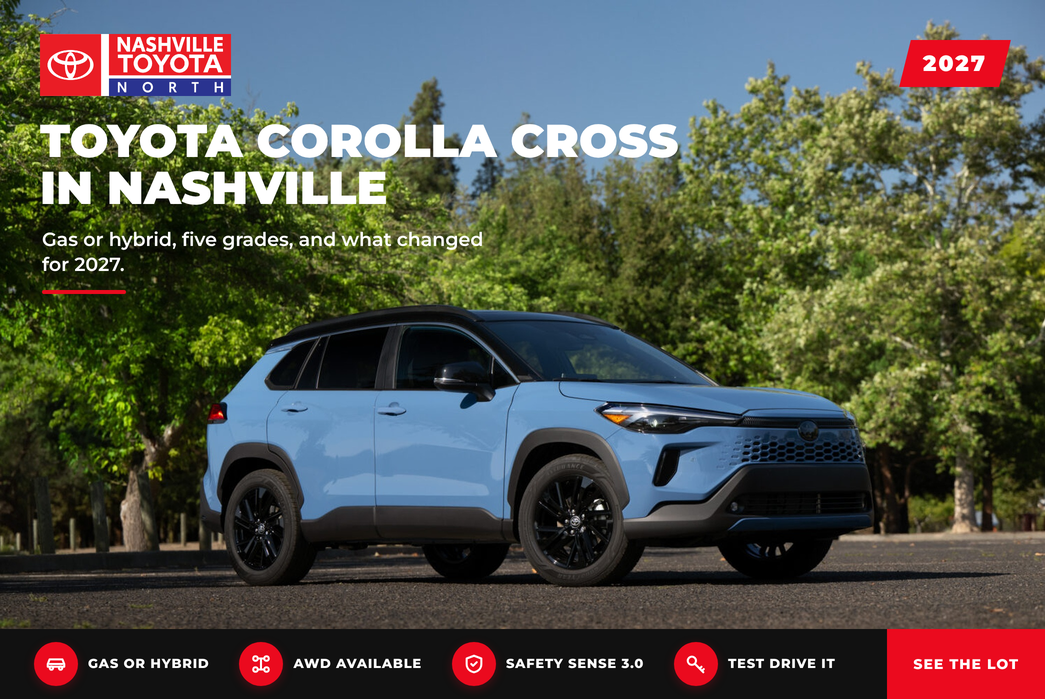
2027 Toyota Corolla Cross Hybrid XSE in Cavalry Blue, featured in a Nashville Toyota North blog post

2027 Toyota Corolla Cross in Nashville: Trims, Features and What Is on the Lot

2027 Toyota Corolla Cross in Nashville: Trims, Features and What Is on the Lot The Corolla Cross has become one of the easiest Toyotas to recommend in Nashville. It is small enough for a Germantown parking spot, tall enough that you can see over traffic on I-65, and it comes as a hybrid with all wheel drive for the mornings when Briley Parkway is slick. Now the 2027 model is arriving at Toyota dealerships this fall, and here is what you need to know before it lands on our lot on Gallatin Pike. What Changed for 2027 Not much, and that is the point. Toyota says the features and specifications carry over from the prior model year. The one change is in the hybrid lineup, which goes from three grades to two. The S grade is gone, leaving the SE and XSE. If you were shopping the gas model, nothing has moved. That is good news if you liked the Corolla Cross already. It means the 2027 model is a known quantity heading into its sixth year in the Toyota lineup. Two Ways to Power It Gas: L, LE and XLE. The gas Corolla Cross runs a 2.0 liter four cylinder engine rated at 169 horsepower, and you can have it with front wheel drive or all wheel drive on any grade. The all wheel drive system is Toyota’s Dynamic Torque Control. It sends up to 50 percent of the power to the rear wheels when it is needed and disengages completely when it is not, which Toyota says helps fuel economy. Toyota’s manufacturer estimated fuel economy for the gas model is 30 city, 32 highway and 31 combined MPG with front wheel drive, and 29 city, 31 highway and 30 combined with all wheel drive. Hybrid: SE and XSE. The Corolla Cross Hybrid uses Toyota’s fifth generation hybrid system with 196 total system horsepower, and every hybrid comes standard with electronic all wheel drive. A separate electric motor drives the rear wheels. Toyota says it distributes driving force to the rear wheels ahead of time to help suppress front wheel slip when you pull away from a stop, and that it helps reduce understeer in corners. Fuel economy for the hybrid is manufacturer estimated at 46 city, 39 highway and 42 combined MPG. For a Nashville commute, the hybrid math is simple. The stop and go stretch of I-24 near downtown and the crawl up Gallatin Pike at 5 PM are exactly where a hybrid earns its keep. Both versions are rated to tow 1,500 pounds, which covers a small utility trailer for a Saturday run to the garden center. Picking a Grade Here is how the five grades stack up, using Toyota’s own feature lists. L (gas). The starting point, and it is not bare. LED headlights and taillights, 17 inch steel wheels with silver covers, fabric seats, rear air vents, two front USB-C ports, an 8 inch touchscreen with wireless Apple CarPlay and Android Auto, and Toyota Safety Sense 3.0. LE (gas). Adds 17 inch alloy wheels, wireless phone charging, automatic climate control, four USB-C ports, a leather trimmed steering wheel, smart key with push button start, roof rails, and heated power mirrors. XLE (gas). Steps up to 18 inch machine finished alloy wheels, SofTex trimmed seats, a 10 way power driver’s seat, heated front seats, dual zone climate control, a 12.3 inch digital gauge cluster, the 10.5 inch touchscreen, and front and rear parking assist with automatic braking. SE (hybrid). The sporty one. A color matched grille and bumper with a smoked Toyota emblem, 17 inch machine finished alloys, paddle shifters on a leather trimmed wheel, wireless charging, four USB-C ports, black roof rails and rear privacy glass. XSE (hybrid). Everything in the SE plus 18 inch black finished alloy wheels, SofTex mixed media seats, the 12.3 inch digital gauge cluster, dual zone climate, ambient lighting and a tonneau cover. There are also a few packages worth asking about: a moonroof package for the LE and SE, a cold weather package with heated steering wheel and heated front seats for the LE all wheel drive and the SE, a JBL premium audio system with nine speakers for the XLE and XSE, and a convenience package with a power rear liftgate and moonroof for the XLE and XSE. Colors Seven single tone colors: Celestite, Jet Black, Wind Chill Pearl, Soul Red Crystal, Cavalry Blue, Sonic Silver and Cypress. Four two tone options pair a Jet Black roof with Wind Chill Pearl, Cavalry Blue, Soul Red Crystal or Sonic Silver. Toyota notes that some of these are premium paints at an additional charge. Safety and Tech on Every Grade Toyota Safety Sense 3.0 is standard across the lineup. That includes a pre collision system with pedestrian detection, full speed range dynamic radar cruise control, lane departure alert with steering assist, lane tracing assist, road sign assist, automatic high beams and proactive driving assist. Blind spot monitor with rear cross traffic alert and safe exit alert are included on the LE, XLE, SE and XSE. The radar cruise control deserves a special mention for anyone who drives I-65 between Rivergate and downtown every day. It holds a gap in stop and go traffic so your right foot gets a break. Every 2027 Corolla Cross also comes with a five year trial of Toyota’s Safety Connect and Service Connect, and the LE, XLE, SE and XSE add a five year trial of Remote Connect, which lets you start the engine or lock the doors from the Toyota app. Toyota notes these are 4G network dependent and need a subscription after the trial. Warranty and ToyotaCare Toyota backs the 2027 Corolla Cross with a 36 month or 36,000 mile basic warranty, a 60 month or 60,000 mile powertrain warranty, and 60 months of corrosion coverage with no mileage limit. On the hybrid, the electric driving components including the traction battery are covered for 8 years or 100,000 miles, whichever comes first. ToyotaCare covers normal factory scheduled maintenance for one year or 10,000 miles, whichever comes first, plus three years of roadside assistance regardless of mileage. What Is on the Lot Right Now The 2027 models are arriving this fall, and our inventory changes week to week. The quickest way to see what is actually here is our new Corolla Cross inventory page, which updates as vehicles arrive. If you want a specific grade, color or the hybrid, call us at 615-656-4242 and we will tell you what is on the ground and what is on the way. Before you visit, check our current Toyota offers for anything that applies to the Corolla Cross this month. Come Drive It A Corolla Cross makes the most sense once you have parked it in a tight spot and merged it onto Briley Parkway, so bring your real commute with you. Our team at Nashville Toyota North on Gallatin Pike can put you in a gas model and a hybrid back to back so you can feel the difference. You can also explore the Corolla Cross model page first, and if you are wondering whether you need something bigger, our RAV4 vs Highlander guide is the natural next step up.

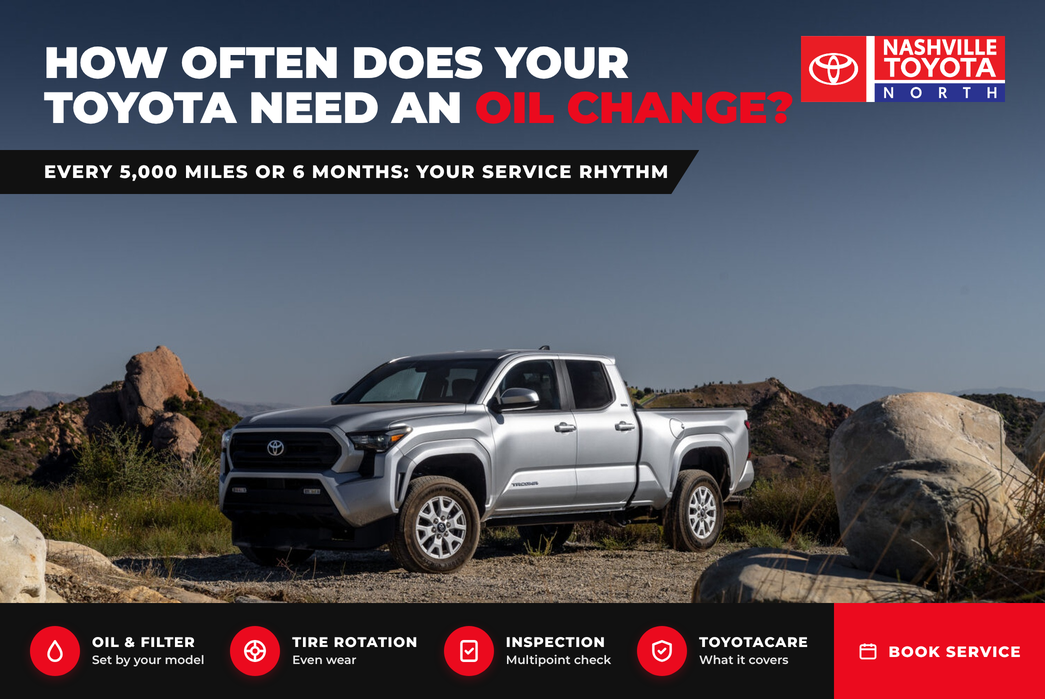
Toyota oil change and maintenance schedule graphic from Nashville Toyota North service center

How Often Does a Toyota Need an Oil Change? A Simple Guide to Toyota Maintenance

How Often Does a Toyota Need an Oil Change? A Simple Guide to Toyota Maintenance “How often should I change my oil?” is one of the most common questions our service team hears. The old rule of every 3,000 miles stuck around for decades, and it still shows up on window stickers at quick lube shops. Most newer Toyotas do not need oil that often, but the real answer depends on your specific vehicle. Here is how Toyota thinks about it, what ToyotaCare covers, and how to find the exact schedule for the Toyota in your driveway. Toyota’s Simple Rhythm: Every 5,000 Miles or Six Months Toyota’s warranty and maintenance guides recommend bringing your vehicle in for scheduled maintenance every 5,000 miles or six months, whichever comes first. That does not mean every visit is an oil change. Think of it as a regular checkup. Depending on your model and the mileage, a visit might include a tire rotation, a multipoint inspection, fluid checks, an oil and filter change, or some combination. Some visits are quick and simple, and some cover more. The “whichever comes first” part matters in Nashville. If you work from home or mostly drive short hops around Madison and Inglewood, you might not hit 5,000 miles in six months. Time still counts, so the six month mark is your cue. So How Often Does the Oil Get Changed? It depends on the vehicle and the oil it uses. Older vehicles that use conventional oil were often changed every 3,000 miles. Most newer Toyotas use synthetic oil, and Toyota’s general guidance for synthetic oil ranges from about 5,000 to 15,000 miles depending on the vehicle. That is a wide range, which is exactly why the right answer for your car lives in two places: Your Warranty and Maintenance Guide. It lists what happens at each service interval for your exact model and year. Your maintenance reminder. Many Toyotas show a reminder on the dashboard when service is due. If you do not have the guide handy, our service advisors can pull up the schedule for your exact vehicle in a minute. Just call or stop by. Toyota’s guides also list extra steps for vehicles that are mostly driven under special operating conditions. If your Toyota does a lot of hard work, ask your service advisor whether those apply to you. What About Tire Rotations? Tire rotations usually line up with that same service rhythm. Toyota’s general guidance is to rotate tires every 5,000 to 8,000 miles. Rotating evens out wear so your tires last longer and the car handles predictably, which you will appreciate on a wet morning on Briley Parkway. Do Toyota Hybrids Need Oil Changes? Yes. A Toyota hybrid has a gasoline engine working alongside its electric motors, and that engine needs oil like any other. Hybrids follow the same idea: regular service visits, with the exact items for your model listed in its Warranty and Maintenance Guide. Hybrids do tend to be easy on some parts. Because the electric side helps slow the car down, many hybrid drivers find their brakes wear more gently. That is a nice bonus, but it is not a reason to skip your regular inspection. Signs Your Toyota Needs Attention Sooner Your schedule is the baseline, but your car will sometimes tell you it needs a look before the next visit. Call us if you notice any of these: A warning light on the dashboard, especially the oil pressure or check engine light An oil level that is low when you check the dipstick, or oil spots under the car New noises, like squealing or grinding when you brake, or a knock from the engine The car pulling to one side, or a vibration in the steering wheel at highway speed A tire that keeps losing air None of these mean something serious is wrong. They do mean it is worth a quick check before a small issue becomes a bigger one. What ToyotaCare Covers Every new Toyota comes with ToyotaCare, a no cost maintenance plan. It covers normal factory scheduled maintenance, including: Engine oil and filter changes Tire rotations Multipoint inspections Fluid level checks It also includes 24 hour Roadside Assistance for 2 years with unlimited miles, which covers things like a battery jump start, a lockout, a flat tire swap to your spare, emergency fuel delivery and towing. Here is what changed recently. The length of the maintenance coverage depends on your model year: Model year ToyotaCare maintenance coverage 2026 and earlier 2 years or 25,000 miles, whichever comes first 2027 1 year or 10,000 miles, whichever comes first Some models, like the Mirai, have their own terms. Our ToyotaCare page has the current details, and it is always worth confirming your own coverage with your service advisor. If your Toyota is a 2027 model, keep an eye on the calendar. Your no cost maintenance ends sooner than it did for earlier model years, so it helps to know when your coverage ends and plan your next visits. After ToyotaCare Ends Once ToyotaCare runs out, the same schedule still applies. Keeping it up is one of the easiest ways to protect your Toyota’s reliability and its trade in value later. A complete service history at a Toyota dealership is something buyers like to see. To keep costs down, check our current service specials before you book, and read our guide to Toyota service coupons in Nashville for more ways to save. Book Your Next Visit Our Toyota service center on Gallatin Pike is open Monday through Friday from 7 AM to 6 PM and Saturday from 7 AM to 2 PM, with factory trained technicians who work on Toyotas all day. Bring your questions about your maintenance schedule, your ToyotaCare coverage, or that dashboard light, and we will walk you through it.